
 Image courtesy of Earth Sciences and Image Analysis Laboratory, NASA Johnson Space Center. ISS015-E-7109
This is too gorgeous for words, so I won't waste many. The image here was taken in early May of 2007 and shows Yellowstone Lake in the mid-to-late stages of its spring thaw. Some of these cracks are enormous - the lake is about 20 miles from the tip of the Southeast Arm (bottom center), where the Yellowstone River enters, to the outlet at Fishing Bridge (center top). And as you can judge from the color, it's really more slush than ice. The lake may have been frozen three feet deep in January and the water never does warm up, even in a hot August, so the thaw is a protracted process.
Here's a view just one week earlier, on the last day of April:
Monday, September 13, 2010
The ice melts

Labels:
photography,
Yellowstone


Saturday, September 11, 2010
Friday photo (belated Saturday edition)
 Multnomah Falls, Columbia River Gorge, Oregon. July 2005.
One of the beautiful things about canyons is that they have steep walls, and the beauty of steep walls is that they create wonderful waterfalls. Here is the most famous one in Oregon, and no wonder: a narrow, 542-foot fall, followed by another drop of 69 feet before emptying into the Columbia River. Also famous because it's so accessible: just 40 minutes from downtown Portland, via Interstate Highway 84. If you were looking for that solitary wilderness experience, never mind; but if you're wiling to share a spot of amazing beauty with a few hundred other people, by all means pull off the highway and visit Multnomah Falls.
 The Columbia River Gorge, home to Multnomah Falls, has a remarkably ancient history. There seems to have been a river here at least 12 million years ago, making it older than the Cascade Mountains. When the Cascades began their uplift, they deflected the river to the north, creating that conspicuous bend downstream of Portland, where the Willamette flows into the Columbia.
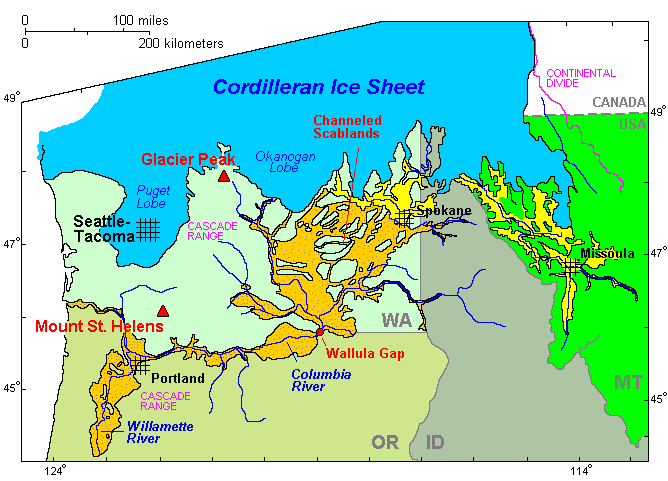
By then, there was probably some sort of canyon here, but the major action occurred only 12-15,000 years ago. During the most recent ice age, expanding glaciers would block up the Clark's Fork River in Montana, creating a vast lake (known as "Glacial Lake Missoula") behind an ice dam. Periodically, the dam would fail, sending some 500 cubic miles of water rushing through Couer d'Alene and eastern Washington at speeds estimated to be as high as 65 MPH. Imagine the combined waters of Lakes Erie and Ontario being emptied in two days - that's what it was like. By the time this water reached the Pacific, it had left behind a deeply scoured landscape in Washington and a wider, deeper Columbia River Gorge. And this flood didn't happen only once, because the ice dam would slowly reform, until it had built up a large enough reservoir to undermine itself again. It happened a least a couple dozen times over several thousand years.1
Multnomah Falls is such a rewarding stop that it comes as a slight surprise that Lewis and Clark didn't single it out for special praise. But it makes sense, because there are more waterfalls than this along the Columbia River Gorge and foot travelers would have seen many of them. L&C merely commented that
several small streams fall from a much greater hight, and in their decent become a perfect mist which collecting on the rocks below again become visible and decend a second time in the same manner before they reach the base of the rocks.However understated, Cpt. Lewis always had an eye for the scenery.
Bonus: a Wasco legend on the origins of Multnomah Falls. The setting of the story, a devastating epidemic of incredible suddenness and mortality, makes me think this legend doesn't predate European contact. Or perhaps it only means that an ancient legend was retold to reflect more recent experiences.
_______________________________________
1. For more information, see Cascades Volcano Observatory - Glacial Lake Missoula; Digital Geology of Idaho - Lake Missoula Floods; GlacialLakeMissoula.org. As always, Wikipedia was also consulted.
Labels:
geology,
nature,
photography
Friday, September 10, 2010
Friday, September 3, 2010
Friday photo
 North State Street Transit Station, Ann Arbor, Michigan. August 2010.
Creeping socialism continues to destroy America. See it? Right in front of your eyes! The destruction of individualism and God-given capitalism is happening right now and only the most discerning Americans can recognize it!
In his 1887 book, Looking Backward, Edward Bellamy explained the crucial distinction between liberty and the socialist nightmare that he hoped to bring about. It's all about umbrellas:
A heavy rainstorm came up during the day, and I had concluded that the condition of the streets would be such that my hosts would have to give up the idea of going out to dinner, although the dining-hall I had understood to be quite near. I was much surprised when at the dinner hour the ladies appeared prepared to go out, but without either rubbers or umbrellas.
The mystery was explained when we found ourselves on the street, for a continuous waterproof covering had been let down so as to inclose the sidewalk and turn it into a well lighted and perfectly dry corridor, which was filled with a stream of ladies and gentlemen dressed for dinner. At the comers the entire open space was similarly roofed in. Edith Leete, with whom I walked, seemed much interested in learning what appeared to be entirely new to her, that in the stormy weather the streets of the Boston of my day had been impassable, except to persons protected by umbrellas, boots, and heavy clothing. "Were sidewalk coverings not used at all?" she asked. They were used, I explained, but in a scattered and utterly unsystematic way, being private enterprises. She said to me that at the present time all the streets were provided against inclement weather in the manner I saw, the apparatus being rolled out of the way when it was unnecessary. She intimated that it would be considered an extraordinary imbecility to permit the weather to have any effect on the social movements of the people.
Dr. Leete, who was walking ahead, overhearing something of our talk, turned to say that the difference between the age of individualism and that of concert was well characterized by the fact that, in the nineteenth century, when it rained, the people of Boston put up three hundred thousand umbrellas over as many heads, and in the twentieth century they put up one umbrella over all the heads.
As we walked on, Edith said, "The private umbrella is father's favorite figure to illustrate the old way when everybody lived for himself and his family. There is a nineteenth century painting at the Art Gallery representing a crowd of people in the rain, each one holding his umbrella over himself and his wife, and giving his neighbors the drippings, which he claims must have been meant by the artist as a satire on his times."
Now UM has replaced its puny little brick bus shelter with this grandiose abomination designed to coddle their students into accepting the nanny state and believing they don't need to take responsibility for keeping themselves dry. Can our final enslavement be far behind?
Thursday, September 2, 2010
Football returns!
For me, summer is just this sports wasteland. I'm not into baseball; the Olympics or World Cup only come around every few years and don't last all summer anyway. I do like IRL and F1 auto racing, but unlike most sports, everyone plays at the same time and so there aren't very many events.
But that's all over now, because college football is back. The long boredom is over. And so I totally feel for this guy.
Via Dr. Saturday.
Labels:
sports
Subscribe to:
Posts (Atom)
