
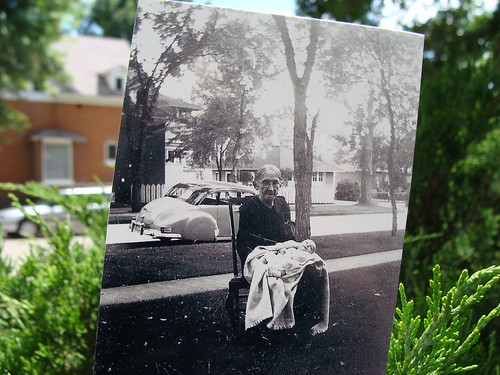
Here's an awesome Flickr pool: Looking into the Past
Then-and-now photos have always been interesting, but Photoshop lets you create a more striking image yet. I might have to try some of this.
Via Millard Fillmore's Bathtub
Saturday, January 30, 2010
Flickr site - comparing past and present
Labels:
history,
photography


Friday, January 29, 2010
Friday photo
 Ames Monument, near Laramie, Wyoming. February 1991.
The Ames Monument honors a pair of brothers, Oakes and Oliver Ames, who played an instrumental role in creating the nation's first transcontinental railroad in 1869.
Oakes was a US Congressman from Massachusetts on the committee for railroads who ended up taking control of the railroad project. His brother Oliver became president of the Union Pacific RR, while Oakes took over the infamous Credit Mobilier company, a construction management company contracting with the UPRR; Credit Mobilier was, all along, a front to defraud investors in the UPRR.
The problem with making a profit in railroading is that you have to create a sustainable business; the beauty of making money in construction is that you get paid first and make your profit even if the railroad ultimately fails. This works even better if the railroad's board of directors are willing to pay inflated prices for your services, and when their board of directors contains the same faces as your board of directors, the negotiations often go smoothly. So Credit Mobilier would offer contracts at high prices; UPRR would pay them; and UPRR investors, believing that the railroad was taking care of its own bottom line, would not realize that their investments were buying far less railroad construction than they should have.
As insurance, Oakes took to cutting his friends in Congress in on the deal, selling Credit Mobilier stock at a steep discount; these gentlemen, in turn, grew less inclined to look critically at appropriations for transcontinental railroads. Eventually, the secret came out and Credit Mobilier became a huge scandal, implicating such prominent Republicans as Indiana's Schulyer Colfax and the future President James Garfield. Oakes died soon thereafter, in 1873, after "suffering" a Congressional censure.
Despite the fraud and the precarious fiscal position of the UPRR, and despite its own shoddy construction practices, the transcontinental railroad was a success, so the damage to the country was probably slight. In Ames's defense, when he took over the railroad had spent several years creating a meandering track of a few dozen miles. By 1869, the Union Pacific and Central Pacific had met up at Promontory Point and goods could travel between the east and west in a fraction of the time they could before. That was a tremendous benefit to the country, even if cranky obstructionists like Sitting Bull claimed otherwise.
The monument itself is a 60' high pyramid, placed at the highest point on the Union Pacific tracks (8,247'). However, the tracks have since been relocated and the Ames Monument was left where it is now, along a dirt road that doesn't go anywhere in particular. It's a pity, because it honors so many elements of the history of its day: the final push to incorporate the entire West into the United States; the rise of distance-destroying technology, especially railroads and the telegraph; the age of unbridled modern capitalism, and almost limitless political corruption of the day (if you think it's never been worse than it is today, you're mistaken).
Labels:
history,
photography,
the West
Thursday, January 28, 2010
Largest book in the world goes on show for the first time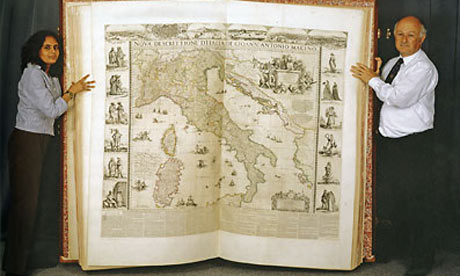
I might have written "therefore" rather than "yet."
Via the Maps-L listserv
Labels:
Archives,
books,
cartography
Wednesday, January 27, 2010
Blogging template
Here's how to do it:
Read moreThis is the title of a typical incendiary blog post
This sentence contains a provocative statement that attracts the readers’ attention, but really only has very little to do with the topic of the blog post. This sentence claims to follow logically from the first sentence, though the connection is actually rather tenuous. This sentence claims that very few people are willing to admit the obvious inference of the last two sentences, with an implication that the reader is not one of those very few people. This sentence expresses the unwillingness of the writer to be silenced despite going against the popular wisdom. This sentence is a sort of drum roll, preparing the reader for the shocking truth to be contained in the next sentence.
via Millard Fillmore's Bathtub
Labels:
communication,
culture,
humor
On loyalty
You gotta love lawyers - they'll stand by their clients no matter how hopeless it looks. Example: four men are caught with a bag of electronic surveillance gear, after pretending to be repairmen so they could get access to the telephones in a Democratic senator's offices. The men are well-known political activists, with views opposite to those of said senator.
The lawyer: "I think it was poor judgment. I don't think there was any intent or motive to commit a crime."
[Update: because he got caught before completing the task, O'Keefe's lawyer can say with a straight face, ""There was no wire-tapping, bugging or interfering with the phone system." ]
Subscribe to:
Posts (Atom)
