
The BBC lists 50 of the most hated Americanisms, as nominated by their readers. Some of them are current business jargon, such as "24/7" and "deliverables." Others have been around quite awhile. One person disparages "expiration date" and wonders what ever happened to "expiry." Truth is, that one expired on this side of the Atlantic some tim before I ever started listening to English. In general, it's the usual collection of pointless peeves that language mavens (including myself, at times) always whine about.
Showing posts with label language. Show all posts
Showing posts with label language. Show all posts
Wednesday, July 20, 2011
Friday, December 17, 2010
Where have all the colors gone?
Finals are over and it's slow on the desk, so I'm playing with Google's latest toy: the Google Books Ngram Viewer. You can graph the usage of words found in Google's collection of scanned books, one at a time, or comparing one phrase against another. It's quite addictive.
But here's a weird trend that I found. If you search for simple words, there's a tendency for their frequency to drop somewhere around 1950, and then begin rising again in the 1990's. Here's a graph of the words blue, red, green, and yellow between 1900 and 2008. Each of them shows this same patter. (I've cleverly arranged for each word to show up in its proper color so that you don't have to read the tiny text)
Other common words show the same thing. For example, man, boy, and girl show that same dip and recovery. Woman appears to start down the same path, and then gets a sudden boost in the mid-1960's. (Damn you, Betty Friedan, for messing with my data!)
Recall that the y-axis represents the frequency of these words compared to other words appearing in print. Did postwar publishing trend away from simpler terms (I mean, "eschew monosyllabary")? And what about the recent trend back upwards? There's been a boom in children's and young adult literature in the past decade or more, but would it make up such a large proportion of publishing as to explain why simpler words are becoming more common again? That's the best guess I have, but I'm none too confident in it. Ideas?
Labels:
information visualization,
language,
publishing


Monday, July 26, 2010
Thursday, July 22, 2010
Our Magnificent Bastard Tongue

The primary difference is that McWhorter doesn't specialize in a single language: he specializes in creoles, those curious half-and-half languages that arise when competing native languages occupy the same space. And he argues that English grammar displays the tell-tale signs of miscegenation, a salad bowl of features that tell the history of Angles and Saxons landing in Celt-occupied England in the 5th Century CE, the Viking invasion of same 300 years later, and the Norman conquest of 1066.
These incidents are well-known, of course, but McWhorter believes their effect on the people's speech is not. Traditionally, the Celtic language is believed to have gone extinct and been more or less completely replaced by the speech we know as Old English. The evidence is the extreme shortage of words in English that can be traced to Celtic origins - the subjugated Celts seem to have contributed almost nothing to the invaders' language. In my own linguistics class years ago, my instructor presented this as a mystery: the absence of Celtic words would suggest that the Celts were quickly killed off; however, the archaeological evidence didn't show an unusual amount of warfare and suggested a long period of coexistence. How to resolve the paradox?
The key to the puzzle may be to approach language with less attention to vocabulary and more attention to grammar. This is what McWhorter does. Throughout the book he displays a familiarity with a vast number of different grammars, especially the funky features that are rare and even unique to one language or another. And through grammar, he sees strong evidence that the Celts lived on for many years, kept their own language, and occasionally spoke English. When they did use English, they added a couple twists that seemed natural to themselves, but probably sounded quite strange to the Angles. Eventually, those oddities began to sound familiar and became the common way to speak.
One of these is the "meaningless do," the semantically pointless addition of "to do" in a sentence when we ask a question or state a negative. It's the reason why all other speakers of a Germanic language can say, "Read you the book?" and get the reply, "I read not the book," but if an English speaker tries that, he sounds like he's channeling Yoda (who, to be fair, did learn his English a long time ago, in a galaxy far, far away1). The English speaker says, "Did you read the book?" and hears, "No, I didn't read the book." "Do" adds no meaning to the sentence, but it is necessary in order to be grammatically correct.
It's a weird construction because none of English's close relatives construct their questions and negatives this way. In fact, this sort of thing is rather rare across the globe. But there are a couple dead languages that are known to have used the meaningless do: Celtic and Welsh. The people who were ruled by invading Angles and Saxons, learned the invaders' language, but continued to speak their own at home. What are the odds that English picked up do from their subjects' language rather than inventing in de novo?2
The Vikings had a different effect on English, an effect that McWhorter describes as "battering" the grammar. If you've put some study into German, you know that its nouns and adjectives rarely appear in sentences as they do in the dictionary. Instead, they take all these damned endings: one of three different endings, depending on whether its gender is masculine, feminine, or neuter, and another for the plural. And each of these will change depending on whether the word is a subject, direct object, indirect object, or possessive. Germans don't seem to have trouble with it, but what a pain for the rest of us!
The Vikings found those endings to be a total pain, too. In fact, it appears that they couldn't get the hang of them at all and just ... dumped them. It must have been a horrid-sounding English to the natives, as horrible to them as it would be to me if someone relentlessly used -ed for every past tense (gived, throwed, hitted, etc.). But the Vikings came in waves of all-male groups, married local women, and raised children who heard this nasty tongue from their fathers, if not their mothers. The version without endings spread, across the country and through the generations. English differs from German today because, to some extent, we speak German like lazy, dumb foreigners.
These developments have been obscured because historical linguists tend to look at written texts for their evidence of past languages. And the written record doesn't seem to show these developments. But McWhorter's explanation is plausible enough: writing was uncommon, reserved for formal occasions, and deliberately preserved the ancient modes. The vernacular changed, but the professional scribes did not deign to record it.3
Then came the Normans. For 150 years, French was the lingua franca4 and the style of formal, written Old English was forgotten. When the English cast off French and returned to their native tongue, they began writing it as they spoke. Suddenly, Middle English enters the written record.
And the Norman influence on English? Although they wrote in French, there is documentary testimony that the Norman overlords were speaking more English than French. However, there were only few of them and they didn't mix with their subjects - their influence on English grammar was negligible. The language picked up an enormous number of French words -- it was written, not spoken, French that left its mark -- but this doesn't seem to interest McWhorter very much. He's much more interest in grammar than vocabulary.
At every turn, McWhorter's analysis of English's evolution is grounded in historical circumstance. The Celts added only a few subtle grammatic changes, a consequence of continuing their own speech apart from the English speakers, but over enough centuries to add a few distinctive constructs. The Vikings mixed with the local people, intermarrying and adopting the local language immediately - but badly, in a grammatically stripped-down form. And the Normans arrived in very small numbers, and remained a tiny elite, apart from the rest of the people; their written documents enriched English vocabulary, but left no mark on its grammar.
Finally, recall that McWhorter studies creoles, specializing in the mixing of languages. He has bones to pick with grammatical nitpickers, the sort who fret over split infinitives, prepositions at the end of sentences, who v. whom, or "He done read the book" (my example, not his). I don't know what he thinks of "refudiate," but you can almost hear him laughing at those prissy grammar Nazis5 who think they're speaking some sort of "pure" English, when in fact their speech is descended through a long line of folks who just didn't know how to talk good.
[Addendum]
As a followup to Heidi's comment, here's a map showing the maximum spread of the Celts. As you can see, they had a pretty wide influence in Europe, although not so much the Scandinavian countries:
_________________________________
1. Although Yoda, as I recall, sometimes uses "do" in the modern manner. He's had a long time to listen to those young Jedi.
2. The progressive "He is reading" is another form that existed in Celtic and today is peculiar to English.
3. It should be no surprise to academics. After all, they're the ones who have to teach their students "You don't write like you talk, dude, or your grade'll suck!"
4. Yes! Pun intended! Would you doubt me?
5. Which, yes, often describes me.

Wednesday, July 14, 2010
You're selling WHAT?

St. Ignace, Michigan. This town gets a lot of travelers, so I suppose someone has told the proprietor that Gift is the German word for "poison."
Thursday, June 17, 2010
"den lilla människan" - the perils of translation
This just came up in, of all places, the archives listserv:
BP's chairman Carl-Henric Svanberg has been taken to task for a statement he made to reporters after a meeting with President Obama and other White House officials: "I hear comments sometimes that large oil companies are really companies that don’t care, but that is not the case in BP, we care about the small people."
Apparently, many listeners were put off by the seeming condescension of the phrase "small people." But the Language Log blog trolls the comments at various sites and finds several people claiming to be native Swedish speakers, who offer up variants on this explanation:
In Sweden we often say “den lilla människan” (lit: “the little human”) when we talk about someone or a group of people who either is up against larger forces or odds, or simply have been unfortunate enough to be caught in the middle between (much) bigger and more powerful players/forces/events.
Plus, would anyone in the US even blink if a Gulf Coast fisherman said, "Someone's got to stand up for the little guy"?
Labels:
language
Tuesday, January 26, 2010
A linguistics scholar at Western Washington is hoping to recover unknown African history by translating an almost-forgotten writing system:
The Lost Script (at the Boston Globe)
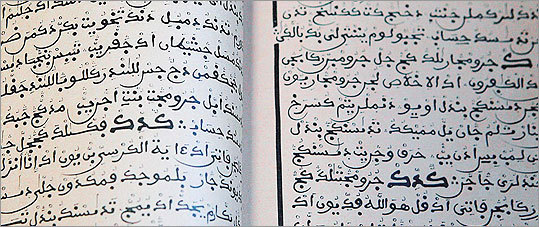
Starting at least in the 10th century, African holy men who had converted to Islam and learned Arabic began to modify Arabic writing to enable them to spread the religion more easily. The resulting Ajami script - the name comes from the Arabic word for stranger - helped make Islam accessible to shepherds and other commoners who could not understand Arabic.
[...]
But officially speaking, it has also been widely ignored. Uncounted Ajami manuscripts squirreled away across the continent have gone untranslated, even unseen, by scholars. Even in African countries where it is still used, the script lacks government recognition. In French colonial archives from Africa, Ngom says, Ajami documents remain classified as “unreadable Arabic” - based on the mistaken notion that writing in African languages simply did not exist.
via the Archives Listserv
Labels:
Archives,
history,
language,
material culture,
writing
Monday, July 20, 2009
Stumbled upon
Did you know there's a province of Thailand called Phuket? And do you suppose everyone knows that the "Ph" is pronounced as a "p", not as an "f"?
[Via Fun Times Had]

Sunday, May 31, 2009
Stumbled upon
It turns out that our language has a word with this unusual property:
It has 9 letters, but you can take one away and still have an English word. Then you can take the 8-letter word, remove another letter, and still have an English word. And so on - you can do this all the way down to a single letter, producing a valid English word every time.
Now, I find that startling.
Labels:
language
Wednesday, May 6, 2009
No long names, please
Via foreignpolicy.com and NYT, we learn that libertarian dystopia Germany has a law against people combining already-hyphenated surnames:
In a split decision on Tuesday, the German Constitutional Court upheld a ban on married people combining already-hyphenated names, forbidding last names of three parts or more.
Which is just hilarious, coming from a people who refer to speeding as Geschwindigkeitsüberschreitung.
Labels:
culture,
free speech,
humor,
language,
liberty
Thursday, April 23, 2009
Close enough for government work?
Error on Longest Place Name to be Fixed
You gotta wonder how anyone could be so careless as to misspell Lake Chargoggagoggmanchauggagoggchaubunagungamaugg. Not once, but twice.
Thanks to the Maps-L listserv
Sunday, March 29, 2009
Stumbled upon
This has apparently been around for some years, but I just discovered it - someone bought a pirated DVD of Revenge of the Sith while living in China and discovered that the "English" subtitles were better than Lucas's dailogue. Okay, that's low praise, but this gets hilarious. If you didn't know that the ancestral languages of English and Mandarin had diverged long, long ago, this would convince you.
The Backstroke of the West, in which it is revealed that the Jedi Council is actually ... the Presybeterian Church!
Monday, December 8, 2008
Islands of the orcs
Strange Maps has a good one here: the Atlas of True Names, where now-ancient placenames are rendered with their modern translations. So the Orkney Islands, for example, can once again be known as the Isles of the Sea Monsters. Which is still not as good as Eyebrow Head, but it's always hard to compete with the Irish.

Labels:
cartography,
language
Friday, November 14, 2008
Saturday, August 9, 2008
Obama the Anti-Christ?
Seriously. Slacktivist has a fascinating post on what looks to be an attempt to persuade the Left Behind-types that Barack Obama just might be the Beast of Revelation.
It's a very clumsy kind of dogwhistle, though. When torture-apologist Michael Gerson inserted evangelicalisms into President Bush's speeches he did so seamlessly. The intended evangelical audience understood the dogwhistle message, but it was embedded within a coherent message addressed to the larger audience. McCain's ad works as a dogwhistle, but there's no larger message for the larger audience. The Left Behind readers will understand his coded message, but the larger audience will just see him standing there, growing red-faced from blowing into a whistle that appears not to work.
Wednesday, July 2, 2008
Books - Nim Chimpsky

Actually, it would be better to describe the book as the story of the subject of that research; the title does not mislead. Nim was caught in an impossible situation: raised by people who had no experience with apes and the limitations of nurture, in the middle of an under-planned and poorly administered study with unclear goals and virtually no budget. As he grew larger, stronger, and more self-willed, Nim became dangerously impossible for amateurs to handle (he sent many to the hospital, at least once with permanent injuries). Nor did it help that some of the key participants seemed to engage in as much infighting as they did research - Nim had a way of provoking strong feelings, while careers and professional status were on the line for most of the people as well. Few of the human actors come out entirely clean, at least if anyone else in the story has anything to say about them.
As he became older and more difficult to handle (perfectly normal for a male chimpanzee, but intolerable for humans who like to keep their flesh and furniture intact), Nim was transferred back to his birthplace at the Institute for Primate Studies at the University of Oklahoma. The language education continued - under different researchers with different ideas of how it should be done - until the IPS shut down in 1981 amid poor funding and poor conditions. A public outcry, led by animal advocate Cleveland Amory, narrowly saved Nim from a medical research facility (most of the other IPS chimps were not so lucky) and he spent his last years at Amory's Black Beauty Ranch in Texas. Those years were tragically short, as Nim succumbed to a sudden heart attack in 2000, barely middle-aged at only 26 years old.
The language studies themselves were inconclusive, which may have been the inevitable results for the first efforts. In the 1970s, the field was dominated by Skinnerian behavioralism on the one hand, and Chomsky's position that syntax and grammar are the essence of language and only humans can have it. Certainly Nim learned to use signs in a purposeful way, but most of the data was not rigorous enough to stand up to hostile scientific scrutiny; videos of his performance left open the possibility that he was employing the "Clever Hans" effect as his handlers praised his successes.
Much of the discussion, though, has always struck me as misguided. The insistence on grammar and syntax as the litmus test of "language" seems a distraction at worst, although not without offering some insight of its own. Sue Savage-Rumbaugh, who performed ground-breaking work of her own with the bonobo Kanzi, complained bitterly about grammar as a red herring. For her, the key factor was that Kanzi had grasped the concept of symbolic representation - this symbol stands for that real-world thing. If the version of the water-pump story we've all learned is accurate, this was the essence of Helen Keller's breakthrough, too. Once she understood what a symbol was good for, she rapidly learned to communicate. Neither Skinner nor Chomsky seem to have considered language from this perspective, but it's a vital insight nonetheless.
As far as I know, there isn't a lot of language study going on these days, but no one doubts the essential personhood of apes any more. One of the tragic consequences of Nim's human environment was that he was always caught between people who saw him as a little boy and those who saw him as a research animal. Nim himself couldn't please either group entirely; he was too wild to be fully socialized into human society, but bonded with his handlers at a level that didn't allow them to seem him treated as a lab rat. Nim moved from houses to cages, saw people enter his life and leave suddenly, and surely never understood any of it.
Subscribe to:
Posts (Atom)
