Friday, July 8, 2011

Friday photo

Devils Tower, Wyoming. December 2004.

I consider this the most perfect photo of Wyoming that I've ever taken. Geology and culture blended seamlessly. Perhaps it would be even more perfect if the grazing animal were a cow rather than a horse, but that's a pretty close call. After all, one could hardly have run cattle without horses. Either way, this is iconic Wyoming.

And Devil's Tower, that magnificent, 867' tall, exposed igneous intrusion. That is, it was a plume of magma that forced its way into the surrounding rock before cooling some 40,000,000 years ago. That seems ancient, but geologically I suppose that counts as recent history. The rock one finds on the surface today is 200,000,000 years old, five times older than the Tower itself. The ground used to be a lot higher than it is today, but that's all gone now, softer sandstone that's been eroded away over the ages, leaving the harder, granite-like plug standing in place, with nothing left to plug but the sky.

When I first visited Devils Tower, perhaps in 1978, Close Encounters of the Third Kind had recently made the site known to the rest of the world and the Visitor Center bookshop was selling Bob Balaban's diary of the filming of the movie (Balaban played François Truffaut's interpreter and had the honor of being the only actor in the movie to utter the phrase, "close encounter"). I no longer have the book, but I recall his account of being driven to the location. Like most of us at the time, Balaban had never heard of Devils Tower and had no idea what he was going to see, just that there was some sort of Point of Interest. His account of the drive went something like this:

Balaban: "Is that it?"

Driver. "You'll know it when you see it."

Balaban: "Is that it?"

Driver. "You'll know it when you see it."

Balaban: "Is that it?"

Driver. "You'll know it when you see it."

Finally they drove around a bend in the road ... and he knew it when he saw it.

Death in Yellowstone

I missed this story a couple days ago, but a hiker was killed by a grizzly bear east of Canyon Wednesday. He and his wife had the bad luck to surprise a bear with cubs, who charged the pair and fatally mauled the man. The Park Service plans no action against the bear, since it seems to have been acting only in perceived self-defense and has no history of aggression against people.

It's only the sixth documented fatality from a grizzly bear in Park history, and the first since two killings in 1984 in 1986 (although perhaps one should also count the death that occurred just outside the arbitrary Park boundary last summer). Both of those victims were hiking alone in bear country, just as I always did. In '84, a Swiss woman died in her tent after taking all proper precautions; Pelican Valley, where she was camping, has been closed to overnight travel ever since. Two years later, a wildlife photographer was killed and devoured by a grizzly near Otter Creek, south of Canyon. His tripod held a camera with a wide-angle lens mounted on it, indicating that he probably made a choice to approach too close to the bear that killed him.1


____________________________________________________________
1. Whittlesey, Lee. Death in Yellowstone, 1995.

Tuesday, July 5, 2011

Dying for what you believe in

My sister's friend likes to say, "Some things are tragedies; others are just too bad." It's a mean thing to smirk at a fatal accident, but when this happens:

A New York man died Sunday while participating in a ride with 550 other motorcyclists to protest the state's mandatory helmet law.

Police said Philip A. Contos, 55, hit his brakes and his motorcycle fishtailed. Contos was sent over the handlebars of his 1983 Harley Davidson and hit his head on the pavement.

He was pronounced dead at the hospital.

"The medical expert we discussed the case with who pronounced him deceased stated that he would've no doubt survived the accident had he been wearing a helmet," state Trooper Jack Keller told ABC News 9 in Syracuse.

Saturday, July 2, 2011

Fast squirrel

The guys on the iRacing forum post some terrific automobile-related videos. This one has a wildlife theme as well:

Friday, July 1, 2011

Friday photo

Rainbow over Hayden Valley. Yellowstone National Park, June 1995.

Rainbows. The only cheaper subject for a nature photographer is sunsets, and that only because they happen to you more frequently. You get especially spoiled living in the mountains, because unlike the Midwest, where the clouds may cover the entire sky for hours on end, a sharp end to the storm is likely to arrive while the rain is still falling. Also, thunderstorms are especially common in late afternoon and when the cloud's edge approaches, the sun is sinking down to the optimal level for creating rainbows (a 42° angle from sun to rainbow to observer).

As far as the mythology of rainbows goes, I'm mostly familiar with the Noah story, where God promises never again to destroy the Earth with a technique that could never have worked in the first place. You can read a quick summary of some alternative mythologies at the relevant Wikipedia article. I often wonder how much anyone took these stories seriously; after all, we all still know the myth of leprechaun's gold at the end of the rainbow, although people who believe it are probably as scarce today leprechauns. Were these stories ever for the adults, or were they always meant as children's entertainment?

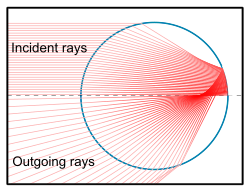
Still, I was a bit surprised to learn how long ago people were trying to figure out how rainbows work, from a naturalistic framework. Based only on surviving writings, we can push it back at least as far as Aristotle in the 4th century BCE. It was probably easy enough to understand that the sunlight was being reflected back from water droplets in the air, since the rainbow always appears in the opposite direction from the sun and, in fact, you don't even need rain. The spray from a waterfall will do nicely. But the Greeks were also damned good with geometry, and Aristotle used these skills to explain how logical it was that that the rainbow should have such a perfect semicircular shape. He grasped that the light had to be reflected at a particular angle back to the observer and that the entire set of points that satisfy this condition would form a circle.*

Figuring out why their are colors is pretty tricky, but sometime around 1300 the Persian astronomer Kamāl al-Dīn al-Fārisī used a large, spherical globe filled with water to model a raindrop and worked out that the ray of light is refracted twice, once as it enters the droplet and again as it leaves, having bounced off the far interior wall. He eventually concluded that the white light was somehow being decomposed into the various colors, anticipating Isaac Newton's famous prism experiments in the 1680's


Traditionally, we divide a rainbow into seven colors, but those bands don't really exist and Roy G. Biv is as fictional as Cupid. The bending of the light is seamless and the change in colors ought to appear perfectly seamless as well. But we don't see color that way. We have three types of photoreceptor cone cells in our eyes that each respond to a different wavelength and what we see is a calculation based on those three inputs. Birds, reptiles, and amphibians, on the other hand, have four or five different types of cones and almost certainly can discriminate colors far better than we can. Set your monitor to 256 colors and take off your glasses - that's probably how a bird would feel if you were to suddenly give them human vision.


_________________________________________________
* The ground cuts off the bottom half of the circle, of course, but full circle rainbows can be seen from the air. I have a cousin who flew on helicopter gunships in Vietnam and tells me that he saw one. I could really envy him the experience, if it weren't for all that war and shooting and danger business that went along with it.