Showing posts with label science. Show all posts

Friday, July 1, 2011

Friday photo

Rainbow over Hayden Valley. Yellowstone National Park, June 1995.

Rainbows. The only cheaper subject for a nature photographer is sunsets, and that only because they happen to you more frequently. You get especially spoiled living in the mountains, because unlike the Midwest, where the clouds may cover the entire sky for hours on end, a sharp end to the storm is likely to arrive while the rain is still falling. Also, thunderstorms are especially common in late afternoon and when the cloud's edge approaches, the sun is sinking down to the optimal level for creating rainbows (a 42° angle from sun to rainbow to observer).

As far as the mythology of rainbows goes, I'm mostly familiar with the Noah story, where God promises never again to destroy the Earth with a technique that could never have worked in the first place. You can read a quick summary of some alternative mythologies at the relevant Wikipedia article. I often wonder how much anyone took these stories seriously; after all, we all still know the myth of leprechaun's gold at the end of the rainbow, although people who believe it are probably as scarce today leprechauns. Were these stories ever for the adults, or were they always meant as children's entertainment?

Still, I was a bit surprised to learn how long ago people were trying to figure out how rainbows work, from a naturalistic framework. Based only on surviving writings, we can push it back at least as far as Aristotle in the 4th century BCE. It was probably easy enough to understand that the sunlight was being reflected back from water droplets in the air, since the rainbow always appears in the opposite direction from the sun and, in fact, you don't even need rain. The spray from a waterfall will do nicely. But the Greeks were also damned good with geometry, and Aristotle used these skills to explain how logical it was that that the rainbow should have such a perfect semicircular shape. He grasped that the light had to be reflected at a particular angle back to the observer and that the entire set of points that satisfy this condition would form a circle.*
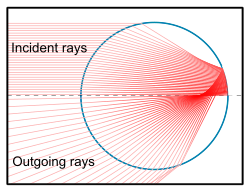
Figuring out why their are colors is pretty tricky, but sometime around 1300 the Persian astronomer Kamāl al-Dīn al-Fārisī used a large, spherical globe filled with water to model a raindrop and worked out that the ray of light is refracted twice, once as it enters the droplet and again as it leaves, having bounced off the far interior wall. He eventually concluded that the white light was somehow being decomposed into the various colors, anticipating Isaac Newton's famous prism experiments in the 1680's


Traditionally, we divide a rainbow into seven colors, but those bands don't really exist and Roy G. Biv is as fictional as Cupid. The bending of the light is seamless and the change in colors ought to appear perfectly seamless as well. But we don't see color that way. We have three types of photoreceptor cone cells in our eyes that each respond to a different wavelength and what we see is a calculation based on those three inputs. Birds, reptiles, and amphibians, on the other hand, have four or five different types of cones and almost certainly can discriminate colors far better than we can. Set your monitor to 256 colors and take off your glasses - that's probably how a bird would feel if you were to suddenly give them human vision.


_________________________________________________
* The ground cuts off the bottom half of the circle, of course, but full circle rainbows can be seen from the air. I have a cousin who flew on helicopter gunships in Vietnam and tells me that he saw one. I could really envy him the experience, if it weren't for all that war and shooting and danger business that went along with it.

Friday, May 27, 2011

Friday photo

Rain on North University Street, Ann Arbor, Michigan. February 2011.


Rain. We have rain. We've had rain. We've had rain all month. We've had rain all spring. We've had rain since late winter. I think I could use up fingers counting the days without rain and still have enough left over to plink out Chopin's "Raindrop" Prelude.1

So far this month Ann Arbor has received over 6" of rain, which is twice the 3" average for May, and it's expected that we'll add to that throughout the weekend2. For April, it was 5.5" and for both March and February it was somewhere around 4" (including snow). This past Wednesday, it was 2.2" in one day. That's a lot of water, far above the monthly average for at least four straight months now.

Fortunately, Michigan drains to both west and east. That means neither the Grand River draining into Lake Michigan, nor the Huron River flowing through Ann Arbor toward Lake Huron, has to contain the full collection of rainfall in the way that the Mississippi River does. Here's a map of the Mississippi drainage. Just look at that! Half the country's waters drain through New Orleans! No wonder the lower Mississippi is so vulnerable to flooding -- they have to receive everyone else's water, not just their own.

So for all the rain we've had in Michigan, flooding has occurred only sporadically. Michigan sheds its excess water quite easily and has enormous basins on either side to catch the runoff. Lucky us.

So far, I've seen no rainbows in the sky, but I don't worry too much about the entire world flooding.3 For that, I have something better than a rainbow: a basic understanding of how the world works and some basic arithmetic. For example, Michigan averages 35 inches of rain per year. But to flood the earth enough to cover the mountains with just 40 days of rain? Let's use that arithmetic: Mount Everest is 29,035' above sea level and there are 960 hours in 40 days and nights. That requires a rate of flooding of 30 feet per hour! Ten times as much water, in a single hour, as a Midwestern state receives in an entire year! That's ... well, incredible. As in "not credible," not to be believed

Where would so much water come from? The ancients of the Near East seem to have imagined that the sky was a solid shell and that the "waters of the deep" surrounded both earth and sky in all directions; when Genesis 1:6 has God declare, "Let there be a firmament in the midst of the waters, and let it divide the waters from the waters," that should be understood as a division in three dimensions, not just two. There was water below the earth and above the sky, so in order to flood the earth, "the same day were all the fountains of the great deep broken up, and the windows of heaven were opened." [Genesis 7:11] For those forty days and nights, the waters were no longer divided from the waters. It wasn't just raining. The earth was simultaneously foundering and receiving an infinite ocean pouring through those windows in the sky. Under that kind of assault, an ark might have to be as watertight as a submarine to avoid flooding itself!

Fortunately, we have a more accurate cosmology today and we know that such quantities of water just don't exist anywhere within reach. The moisture in the ocean, lakes, rivers, and clouds is all there is on earth and if there were enough to cover the entire planet, it would do it every day. That doesn't save us from floods altogether, alas; it just means that floods are very local affairs. Some are big enough to feel like the end of the world, if you were to experience them, such as the Glacial Lake Missoula floods I mentioned last autumn. William Ryan and Walter Pittman have even suggested a breakthrough of the Mediterranean into the Black Sea as the origin of the Flood mythology. But that's a local catastrophe nonetheless; if you have too much water, that just means that somewhere else has less than it did before. Now doesn't that make you feel better?


__________________________________________________________
1. Not Chopin's name for opus 28, no. 15, just so you know.

2. The forecast looks a little better for the race in Indianapolis Sunday, but it's likely to be hot and breezy, which should make life exciting for the engineers. I won't be surprised if some good drivers struggle with unexpectedly slow cars when the race gets under way.

3. We just escaped yet another prediction of the end of the world, so I'm just wallowing in complacency these days.

Tuesday, January 11, 2011

Good popcorn - you need to know this

From "Investigation of the properties influencing popcorn popping quality," Maga J.; Blach, B.; Developments in Food Science (1992), 29, 543-50:

The roles of popcorn moisture content and storage temperature prior to popping as well as popping temperature and the amount of added oil and salt on resulting popped volume and number of unpopped kernels were evaluated. Max. popped volume was in the 12.5-13.5% moisture range while the proportion of unpopped kernels increased with increasing moisture. Popped volume decreased while unpopped kernels increased with an increase in storage temperature. The addition of 2-4% oil maximized popped volume and minimized unpopped kernels. The addition of 2% salt gave the highest popped volume and the lowest amount of unpopped kernels. Optimum popping temperature was 180°.

Wednesday, November 17, 2010

Beautiful Mother Earth

From the USGS, The Earth as Art:


This is the Dasht-e Kevir, the Great Salt Desert in Iran. Mostly uninhabited, for the same reasons that the Mormons stopped when they reached the Great Salt Lake and didn't continue on to the Bonneville Salt Flats.

The whole display consists of 41 LANDSAT 7 images, selected for their aesthetic qualities rather than for their informational value. Some of the colors will look unnatural, as LANDSAT captures images in a variety of wavelengths of the visible and infrared spectra. My favorites are those that don't get too radical with the coloring, but your tastes may vary (i.e., be wrong).

And if you like these, you'll want to check out the sequels, Earth as Art 2 and Earth as Art 3.

Thursday, September 30, 2010

Friday photo (special Thursday edition)

Mercury and Moonrise over Absaroka Mountains,
Yellowstone National Park. September 30, 1997.

(Be sure to click on the image for the enlarged version)

My 35mm slides are dated only to month and year, but according to Stellarium, this conjunction of Mercury and the new moon occurred on September 30, 1997. I didn't know it just yet, but that was the day my brother's wife gave birth to their first daughter. In fact, I never connected that event to this photo until I was preparing to post it a couple months ago. So here's wishing a Happy Birthday to Olivia, whose birth 13 years ago was announced with unusual and beautiful signs in the heavens.

And Mercury is an unusual sight, even if the moon weren't so close by*. Most folks will never glimpse it -- not knowingly anyway. Being closer to the sun than Earth, it can only appear at sunrise or sunset, like Venus does, but it's so much closer to the sun that it's usually much harder to spot. It needs to be well out to the side, as seen from Earth, or it's overwhelmed in the sun's glare. Also, if its path around the sun - the ecliptic - is parallel to Earth's horizon, then it will rise at the same time as the sun and again the sky is too light. The best viewing is in the early spring or early autumn, when the ecliptic is more vertical to our horizon. This allows Mercury to rise higher before sunrise, or set later after sunset, when the sky is slightly dimmer, like so:

This is the arrangement on 9/30/1997, so you can see that Mercury was in a good position, although not the best. However, I wanted the moon in the photo, and the moon changes position every day; it was the 30th or nothing.

t also happens that Mercury is most visible when it's on the opposite side of the sun from Earth, even though it's farther away then. Otherwise, even though it's closer, it presents mostly its dark side to the world -- much like the moon in the photo, or a Goth chick.


____________________
* "Close by," of course, as viewed from Earth. The planet was actually 500 times farther away than the moon was.

Thursday, September 23, 2010

A pox am I

Have you ever wondered what sort of protein you would be, if the letters in your name corresponded to amino acids? Of course you didn't; only a complete geek would wonder something like that.

So a f(r)iend threw my name into this Name-to-DNA translator and, well, here are the results:


The highlighted portion reads: "This protein is found in the species Camelpox virus (strain CMS)."

So be nice to me or I'll make your camel sick.

Thursday, July 22, 2010

Testing 1/6 G

Here's a cool Mythbusters segment, where they test NASA video of astronauts' movement on the moon:

Friday, May 14, 2010

Friday photo

Clouds, Grand Canyon National Park. February 1989.

The Grand Canyon is not a glacial artifact, but if it were, it might have looked like this once upon a time. Maybe not so fluffy, but there would have been ice and snow piled thousands of feet deep high. But there has never been a glacier in the Grand Canyon, either in the deep past or when I lived there. What we're looking at here is a low bank of clouds.

This particular event was caused by a temperature inversion, when the air near the surface - normally warmer than the air above it - cools down until it's colder than the layer above. When that happens, the higher and warmer air acts like a lid, preventing the surface air from rising and remixing as it normally would. Here, that warm layer lay below the rim of the canyon, leaving the clouds nowhere to go. From above, you could easily imagine that the clouds filled the canyon all the way from the bottom, that wasn't the case: it only took a short hike down the trail to come out into clear air again.


Temperature inversions in populated areas can pose a serious health hazard, as they trap air pollutants near the ground. They frequently occur in the winter, when the long nights allow greater cooling, and in the mid-20th Century, when every home ran its own coal furnace, the effects could be horrific. In 1952, an inversion settled over London for five days, trapping their smog at ground level. When it finally lifted, as many as four thousand people had died, most of them probably with preexisting respiratory problems.

Saturday, May 8, 2010

What you should be reading

Btw, if you're not following the adventures of Charles Babbage and Ada Lovelace at 2D Goggles, then why the hell not?

Wednesday, April 7, 2010

ISS and the moon

The International Space Station crosses between moon and Earth.


Do click on the image for a larger version.

NASA image of the day, via Bad Astronomy

Friday, April 2, 2010

Perpetual Fool's Day

Yesterday you may have participated in April Fool's Day, that once-a-year appreciation of deceptive bullshit. But in the world of religious apology, every day is Fool's Day. So let's have some cheap fun with this bit of wishful thinking from one David R. Reagan:

Stoner begins with a very interesting observation. He points out that his copy of Young's General Astronomy, published in 1898, is full of errors. Yet, the Bible, written over 2,000 years ago is devoid of scientific error. For example, the shape of the earth is mentioned in Isaiah 40:22. Gravity can be found in Job 26:7. Ecclesiastes 1:6 mentions atmospheric circulation. A reference to ocean currents can be found in Psalm 8:8, and the hydraulic cycle is described in Ecclesiastes 1:7 and Isaiah 55:10. The second law of thermodynamics is outlined in Psalm 102:25-27 and Romans 8:21. And these are only a few examples of scientific truths written in the Scriptures long before they were "discovered" by scientists.

Gosh, the Bible is a basic science textbook? Let's see what we can learn!

Isaiah 40:22:
"It is He who sits above the circle of the earth, And its inhabitants are like grasshoppers, Who stretches out the heavens like a curtain And spreads them out like a tent to dwell in."

Yep, the earth is round - but round in a flat, 2-dimensional way, not spherical in 3 dimensions. Thus the expression "pennies from heaven," perhaps. So not only do we live in Flatland, we now know that when God plays games with us, he's playing disc golf, not basketball.

Job 26:7:
"He stretches out the north over empty space And hangs the earth on nothing."

Deriving F = Gm1m2/r2 from this verse is left as an exercise for the reader. Speaking of stretching, it's quite a reach to get even a mention of gravity from this verse. No mention that the gravitational attraction between the sun and earth is what keeps our planet from flying off into cold empty space. We don't even get informed that things fall to the ground, but maybe that's because the reference in Job 5:7 to sparks flying upward would hopelessly confuse us.

Ecclesiastes 1:6:
"Blowing toward the south, Then turning toward the north, The wind continues swirling along; And on its circular courses the wind returns."

Because before people started quoting the Bible, no one had ever encountered a windbag arguing in circles before ....

Psalm 8:8:
"The birds of the heavens and the fish of the sea, Whatever passes through the paths of the seas."

That's all you need to know about the circulation of ocean currents. Seizing upon the word "paths," I suppose we could even work this out as an anticipation of plate tectonics, too, since if paths implies currents, and there are paths on the ground, then that would imply earth currents, too. See? You can find it all there, once someone else has gone and discovered it for real.

Ecclesiastes 1:7:
"All the rivers flow into the sea, Yet the sea is not full. To the place where the rivers flow, There they flow again."

Isaiah 55:10:
"For as the rain and the snow come down from heaven, And do not return there without watering the earth And making it bear and sprout, And furnishing seed to the sower and bread to the eater;"

A lazy student might not connect the verse in Ecclesiastes to rain and snow, or the verse in Isaiah to rivers and oceans, but please! Pay attention! Does God have to spell out every detail? There's only one book between Ecclesiastes and Isaiah in the Protestant Bible, although it does happen to be the Song of Songs and all that sexy imagery can distract.

Psalm 102:25-27:
"Of old You founded the earth, And the heavens are the work of Your hands. Even they will perish, but You endure; And all of them will wear out like a garment; Like clothing You will change them and they will be changed. But You are the same, And Your years will not come to an end."

Romans 8:21:
"the creation itself also will be set free from its slavery to corruption into the freedom of the glory of the children of God."

Yep, things wear out. That's not quite what the Second Law of Thermodynamics says, but it's a true statement nonetheless and we all know that atheists denied the Theory of Wear & Tear for ages before scientists rediscovered it (although the atheists still deny the evidence - even the octogenarians). They also discovered the Third Law, which states that entropy is arrested only when the temperature reaches absolute zero and
all processes cease. You always suspected that Hell would be a more happening place than Heaven, didn't you?


So that's it. If anyone ever insists that there's science in the Bible, you have a pretty good idea what they're talking about - parenthetical banalities that wouldn't surprise a six-year-old. While the Greeks and the Chinese were proving the Pythagorean Theorem, the Hebrews weren't even trying. Jews do a lot better these days, but some Christians prefer intellectual stagnation as much as they long for an unchanging Heaven.

Tuesday, March 2, 2010

God for a day

Via Bad Astronomy, here's an awesome time-waster: model your own solar system!

Bad Astronomy's headline uses the phrase "destroyer of worlds" and that is the most frequent outcome when you first start tweaking parameters. Too much velocity and planetoids get flung into deep space; or collisions will wipe out one or more of your planetary bodies.* Fledgling gods need practice, too. Here are a couple of the more interesting systems I've generated so far.

In this one, the tiny blue body began as a moon of the heavy Planet Pink, but with a highly eccentric orbit. After a few circuits, its apogee fell at right angles to Pink's orbit, taking the Blue Moon so close to the sun that it was captured in the eccentric orbit that runs from the one o'clock position to seven o'clock. Not long after, the Pink skewed Blue's orbit again, this time into a more circular path. Since then, it's been pretty stable.


In this one, Blue's orbit around Pink also has high eccentricity, but is also smaller, so it doesn't get away. But the path is interesting: where the long axis of Blue's orbit lines up with Pink's orbital path, a curlicue path results, but at other positions it the loop disappears and Blue's path resembles a distorted sine curve.


Cool stuff, even better than Spirograph.


_____________
* Unfortunately, collisions aren't modeled - the smaller body just disappears, rather than adding a fraction of its mass to the larger body and then bouncing off in some other direction.

Saturday, February 20, 2010

"Sonic Boom Meets Sun Dog"

I have to share this video, found at Bad Astronomy:

Friday, February 12, 2010

Friday photo

Bristlecone Pine, California. June 2005.

If you want to put human history into perspective, just reflect on the bristlecone pine. High up in the White Mountains of California is a tree that the US Forest Service has chosen to call "Methuselah," because it is oldest known tree in the world. It's almost an insulting moniker, to tell the truth. Methuselah of the Bible was reported to be 969 years old when he died. When the Methuselah tree was a mere 969 years old, there wasn't even a Bible yet. There was no code of laws from Hammurabi yet and it would be at least another 800 years before the House of David ruled in Judah; bronze represented the peak of the metallurgical arts. That's what we call ancient history, when this tree was already nearly a thousand years old. If the core samples are correct, the Methuselah tree sprouted in the year 2831 BC, before the Egyptians had gotten around to thinking, hey, we could stack some towers on top of each other and call them pyramids.

It's one of the few experiences that I consider awe-inspiring - contemplating a living thing whose lifespan has encompassed almost all of what we consider the History of Civilization. When I first encountered the sequoias, their age always impressed me even more than did their size. Some of them are well over 3000 years old, about the age that King David would be if he could have kept adding growth rings down to the present. Amazing, yet the oldest sequoias are young compared to the oldest bristlecones.

The tree in the photo above might be Methusaleh , although it probably isn't. When you visit this grove, the Forest Service literature explains that they're just not going to tell you which tree is the oldest one, because there are a lot of assholes out there who might think it cute to vandalize such a special tree, and for all they know, you might be one of those assholes, so you're just going to have to get by without knowing for sure. They're more diplomatic about it, but that's what they really mean, and they're entirely correct, of course.

The most amazing thing about bristlecones is how underwhelming they are on first sight. Even the oldest - especially the oldest - are just rather squat and twisted, thick but short. The oldest trees live in dry conditions and add only a thin ring of growth every year, resulting in a dense wood that resists decay and insect infestation. Many of them have been nearly girdled, with only a narrow strip of bark keeping the entire tree alive; if you look at the photo again, you'll see that most of the bark is gone, yet the tree still lives.

Because they preserve so many years of growth rings, bristlecones are a perfect subject for dendrochronology, the science of discerning the patterns of wet and dry years by identifying the wide and thin rings in trees. The living tree allow you to peg the record to the present day, while the rings of long-dead trees can be matched up with those living trees to push the record back even farther, in some regions back to 10,000 years with accuracy to the very year. It's an impressive climatic record. At the top of this post, I had to use ancient Near East history to provide context for the Methuselah tree, because no comparable written records exist for California. But there is a historical record there, nonetheless. The bristlecone pines have witnessed thousands of years of that history and are still able to tell us about some of it.

Sunday, January 17, 2010

Friday, January 8, 2010

Coywolves?

Ralph Maughan's Wildlife News reports on a draft research paper which finds that, in New England, a sample "coydog" hybrids doesn't contain any domestic dog DNA. Instead, they are hybrids of coyotes and eastern timber wolves (canis lycaon). Interesting stuff that I knew nothing about ....

Tuesday, January 5, 2010

Life, the universe, etc.

On the Maps listserv, Brendan Whyte of the National Library of Australia points to this atlas of the universe from the Hayden Planetarium:


Also check out the FAQ's, where you'll find interesting answers to questions like "Why should life be carbon based?", where Saavik Ford explains how carbon atoms have the ability to bond with four other atoms at once, thereby making long and complex molecules that are capable of causing interesting chemical reactions.

Sunday, December 20, 2009

Under Yellowstone

A cool, and (somewhat) interactive, graphic illustrating the magma plume that probably underlies Yellowstone and the Snake River plain. From National Geographic:

Under Yellowstone

Sunday, December 6, 2009

New species before our eyes?

From Wired.com, could English birdfeeders inadvertently cause a speciation event?

Central European blackcap warblers that spend the winter in the birdfeeder-rich United Kingdom are on a different evolutionary trajectory than those that migrate to Spain. The population hasn’t yet split into two species, but it’s headed in that direction.

“This is reproductive isolation, the first step of speciation,” said Martin Schaefer, a University of Freiburg evolutionary biologist.
*snip*

About 30 percent of blackcaps from southern Germany and Austria now migrate to the United Kingdom, shaving 360 miles from their traditional, 1,000-mile Mediterranean voyage. Because they’ve less distance to travel, they tend to arrive home first in the summertime and to live in prime forest-edge spots. All this makes the U.K. migrants more likely to mate with each other than with their old-fashioned brethren.

Schaefer says he doubts that birdfeeders will be around long enough to complete the task, but it's a fascinating prospect nonetheless.

Tuesday, December 1, 2009

God agrees with me. He's pretty smart that way.

From Not Exactly Rocket Science, via Pharyngula:

For many religious people, the popular question "What would Jesus do?" is essentially the same as "What would I do?" That's the message from an intriguing and controversial new study by Nicholas Epley from the University of Chicago. Through a combination of surveys, psychological manipulation and brain-scanning, he has found that when religious Americans try to infer the will of God, they mainly draw on their own personal beliefs.
* snip *
The brain scans found the same thing, particularly in a region called the medial prefrontal cortex (mPFC) that's been linked to self-referential thinking. The mPFC is more active when we think about our own mindsets than those of others. Epley found that it was similarly abuzz when the recruits thought about their own attitude or God's, but lower when they considered the average American.
I was going to make a quip about the research appearing in the Journal of Unsurprising Results, but I honestly find that last bit rather startling. According to Epley, people use a different part of the brain to infer what other people are thinking, but use the very same part of the brain to reflect on either their own thoughts or their inference about God. That would seem to suggest that creating God in one's own image isn't just an act of bad faith; it could be exceedingly difficult to avoid.