Friday, April 8, 2011
Friday photo
Here's a photo of Topnotch Peak, one of the more identifiable peaks of the Absaroka Range that forms Yellowstone's eastern boundary. It's a fairly generic photograph, just a mountain top rising above the forest. It doesn't even give you a good view of the eponymous “notch.” In fact, I find the photograph so non-descript that I'm slightly surprised to have found it still amongst my 35-mm slides.
I recall a conversation in the Employee Dining Room at Lake once: one of my coworkers was explaining to someone how he had thrown away thousands of slides over the years. “Oh, you throw them away because you don't have room to keep them?”
“No, I throw them away because they suck!”
I've thrown away a lot of slides over the years, for both of those reason. Some were just too dreadful to ever pass muster with the editor (me). Others were not bad, but I didn't have room to save every slide I ever shot. I was traveling between Yellowstone every summer and wherever I was during the winter. I lived out of dorms for the entire 1990's, moving at least twice a year and having to pack all my belongings into a Ford Escort. You get good at packing; I recall having to empty the entire car to get at the spare tire on the side of a Nebraska highway one night, repacking to get back on the road, then repeating the process at the tire shop the next morning. One of the guys in the shop just shook his head in amazement: “I never thought that would all go back into that car.” Having my entire photo collection whittled down to three 3-ring binders was just one way of keeping the load manageable.
It means that there are some feature or places for which I have no photographic record at all, because whatever picture I took of the place didn't survive the editing process. If I didn't like it as a photograph, I didn't save it as a “record shot.”
Now that I don't need to save space, it's ironically so much easier to save space. I no longer throw away – i.e., delete – digital photographs, because I can easily archive everything onto a hard drive that's smaller than a desk phone. And those two bulky cases filled with 120 cassette tapes are gradually being replaced with MP3 downloads (the later collection of CD's having already been ripped to disc) and I can have as much music as I desire without worrying about where I'm going to fit it all.
The electronic gadgets sure makes the peripatetic life more comfortable. In fact, I read a blog entry a couple years ago about a young man who was experimenting with being homeless. He had a duffle bag with clothes and a few electronic devices that gave him all the music and reading material he needed, while still being able to carry everything he owned. He was also depending on a network of friends to provide him with couches to sleep on, so I don't expect he's made a permanent life out of it. But the idea that you could have such an array of cultural amenities without a permanent home to store it in still amazes me. How Young Me would have envied Old Me!
Labels:
technology,
Yellowstone
By
Scott Hanley
Thursday, March 10, 2011
Found in the archives
A volunteer at the Smithsonian Institute has discovered color photographs of San Francisco after the 1906 earthquake.
Although hand-colored photographs of the quake's destruction have surfaced before, [Eugene] Ives' work is probably the only true color documentary evidence, Shannon Perich, associate curator of the Smithsonian's photography history collection, told the Chronicle.
Update: the volunteer himself blogs the discovery
Labels:
Archives,
history,
technology
By
Scott Hanley
Wednesday, October 20, 2010
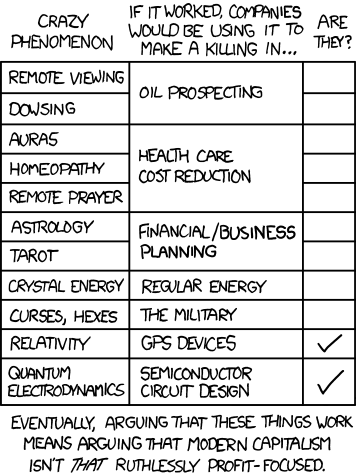
The other Art of the Possible
xkcd offers another way to spot BS:
Labels:
belief,
technology
By
Scott Hanley
Thursday, September 30, 2010
On the revolutionary(?) power of social networking
Malcolm Gladwell has a thought-provoking article at the New Yorker, entitled "Small Change: Why the revolution will not be tweeted."
The upshot: social networking fosters many weak ties, with weak enthusiasm and commitment. Comparing that to the tightly-organized civil rights movement, he argues against the ability of Twitter networks to create revolutionary change.
Labels:
culture,
technology
By
Scott Hanley
Monday, August 30, 2010
OED going all digital?
Here's a careless bit of writing:
The Oxford English Dictionary, as legendary as it is heavy, is facing a bleak future as there's not much of a market these days for a reference book that weighs 130 pounds.The point, of course -- and the article does get this right, despite those poorly-paired paragraphs -- is that the OED is doing just fine. In fact, it might be doing even better now that its clumsy technological limitations have been overcome. People are using the OED.
The dictionary's publisher, Oxford University Press, said that the OED's online version gets two million hits a month. And that's from users who pay $295 a year to be able to access the exhaustive word list.
That $295/year, by the way, is the subscription rate for individuals and I expect most of those 2 million hits are coming from academic institutions who pay more, but provide most of the users. It's true that the OED online will never inspire the same awe as the rows and rows of hardbound volumes did -- but dammit, now everyone can use the thing!
Labels:
commerce,
technology
By
Scott Hanley
Thursday, August 5, 2010
Unsurprising news to librarians
From Inside Higher Ed:
“The digital divide used to be about the hardware haves and have-nots,” she [Susan Zvacek, director of instructional development at the University of Kansas] said. “What we’re seeing now is that it’s less about who has hardware, but who has access to information; who has those problem-solving skills. And that’s going to be the digital divide that we’re going to see in the future … the ability to deal with information.”
The assumption that today’s student are computer-literate because they are “digital natives” is a pernicious one, Zvacek said. “Our students are task-specific tech savvy: they know how to do many things,” she said. “What we need is for them to be tech-skeptical.”
And from the New York Times:
A new study coming out of Northwestern University, discovered that college students have a decided lack of Web savvy, especially when it comes to search engines and the ability to determine the credibility of search results.
Young people today use technology, but it doesn't mean they understand what they're doing, anymore than driving a car makes me an auto mechanic (and it doesn't, not one bit). But it may be unfair to pick on the youngsters: their elders once trusted Walter Cronkite and now they give that same uncritical allegiance to Rush Limbaugh. Information assessment is a crying need ... and I'm seeing librarians, knowing they can't survive as curators of books, eager to take on this task that almost no one else wants to do.
Labels:
information seeking,
libraries,
technology
By
Scott Hanley
Wednesday, May 26, 2010
World's first mobile phone
This is remarkably cool: a demonstration of the world's first (AFAWK) mobile phone, in 1922:
I was surprised to see the fire hydrant mentioned as evidence of an American city. British cities don't/didn't have fire hydrants?
Via RAIN
Labels:
Archives,
communication,
history,
technology
By
Scott Hanley
Wednesday, April 7, 2010
ISS and the moon
The International Space Station crosses between moon and Earth.
Do click on the image for a larger version.
NASA image of the day, via Bad Astronomy
Labels:
photography,
science,
technology
By
Scott Hanley
Tuesday, March 16, 2010
Visual spring
From the Maps-L listserv, see how much snow has disappeared from the ground in Wisconsin between March 8 and March 15:
See more MODIS imagery at Wisconsin View
Labels:
nature,
photography,
technology
By
Scott Hanley
Saturday, February 20, 2010
"Sonic Boom Meets Sun Dog"
I have to share this video, found at Bad Astronomy:
Labels:
science,
technology
By
Scott Hanley
Saturday, January 23, 2010
Malware
I just received a message from a Facebook friend that purportedly connects to a YouTube video. However, the video doesn't play: it just pops up the message that I need to download Adobe Flash Player 10.37 in order to view it.
A quick Google search turned up this page, confirming that there is no Flash Player 10.37. It's a scheme to install spyware and adware on my machine.
While my internet practices probably aren't as safe as they should be, one of my rules is to never download a piece of software from the website that tell me I need it. In this case, I was looking for Adobe on the assumption that their Flash Player downloads don't contain spyware, while an unknown person's link just might.
Be warned.
Labels:
security,
technology
By
Scott Hanley
Tuesday, November 17, 2009
The well-engaged couch potato
An interesting article by Kent Anderson at The Scholarly Kitchen argues that DVR's allow viewers to pay more attention to their tv-watching - including the ads.
The main point: DVR's give people control over their viewing, so they're more active about what they watch. Passive viewing generally means paying less attention to what's on the screen.
To escape ads before, people would use the time to use the bathroom, make a sandwich, make a phone call, or check email (more recently). In fact, there was once an urban legend about plumbing problems being cause during commercial breaks during the Super Bowl. Running at normal speed, commercials allowed for 2-3 minutes of activity away from the television. Sped up using a DVR, people don’t leave the room.
Viewers have to watch the ads to use a DVR effectively. You have to know when the ads stop and the show resumes, which means watching the ads as they go by. Even at a high speed, the ads register. And people do watch carefully. As Hammock puts it so nicely, “Often, the person with the control is being judged by a second party for their finesse in stopping the fast-forwarding at the precise time it needs to stop, so, therefore a second party is also engaged in looking at the sped up commercials.”
Anderson is certainly right that few people were really watching all those ads anyway. Most of us are multitasking like mad when the tv's on. It's a rare program that has my undivided attention.
As an aside, I don't have a DVR, but I have found that I pay far more attention to a Netflix program streaming to my computer than I do to a DVD playing on the television. This seems to have more to do with the size of the screen than to any other factor. To watch on the computer, I pretty much have to keep the laptop on the lap, and I can't really surf the net or browse a book at the same time. I do like being able to carry it into the bathroom with me, though.
Labels:
media,
technology
By
Scott Hanley
Tuesday, October 27, 2009
electronic v. print
Transitional phases can be confused and inconsistent. How confused is the transition from print to electronic publishing? UM's Taubman Medical Library has five print copies of the "APA Style Guide for Electronic Resources":
Labels:
libraries,
technology
By
Scott Hanley
Monday, October 19, 2009
On progress
Has any company in the world ever inspired so much fear through the phrase "new and improved" as Microsoft does?
The 7 Deady Sins of Windows 7
(I was a bit taken aback at the reference to Windows' "leaner, meaner predecessors." As I recall it, Windows 95 was already considered a resource hog.)
Labels:
technology
By
Scott Hanley
Saturday, October 17, 2009
Back in July I wrote about a case where ASCAP is suing Verizon, claiming that musical ringtones on cellphones are a "public performance" and Verizon should pay performance fees; this depite - no, in addition to - the fact that Verizon already pays fees to ASCAP for selling these ringtones.
On Wednesday the judge ruled in the case and, wise public servant that she is, entirely agreed with me. Although the words were measured, the upshot was that ASCAP's case was ridiculous and was a misreading of both law and fact in virtually every aspect. A ringing phone is not a "public performance" by either the customer or the provider, signalling the phone to ring is not the same thing as playing a recording, and no amount of wishful thinking allows ASCAP's lawyers to redefine legal standards and the physics of wireless communications to their convenience. They still get paid for ringtone sales, but they don't get to doublecharge by pretending Verizon is both a music store and a radio station.
Labels:
copyright,
intellectual property,
law,
technology
By
Scott Hanley
Saturday, October 10, 2009
Patricia sent me this link of Ohio as a piano. Andy Woodruff at the Cartogrammer.com blog has seized on the coincidence that there is exactly one Ohio county for each key on a piano and mapped the sounds to the map so that clicking or mousing over a county plays that note.
Where it gets interesting is that you can remap the sounds, according to the available GIS data. Low values play low notes, high values play high notes. Most of the music is too John Cagish for my taste, but I liked the Crop Acr97 mapping, where you can literally hear Ohio grow more farmable as you move southeast - northwest.
Labels:
cartography,
music,
technology
By
Scott Hanley
Thursday, October 1, 2009
The networked world
Many developing countries have connected their people with telephones by skipping the land-line phase and going directly to cellular phones. The Economist predicts that world-wide access to the internet will arrive in similar fashion, via mobile broadband technology.
Labels:
communication,
technology
By
Scott Hanley
Tuesday, September 29, 2009
Court case regarding evidence on computers
Here's an interesting court decision that came down recently: investigators who are searching a computer under a search warrant may not seize files that provide evidence of a different crime than the warrant provided for.
It's another example of established law running into confusion when it encounters new technology. Search warrants are made out for specific purposes, so if the police come to search for evidence of one crime, they can't seize on evidence of a different crime - unless the evidence of that other crime is in "plain view." Its a fuzzy standard, but the purpose is clear enough - if the searchers happen to see a corpse in the hall or drugs on the coffee table, they're not obliged to ignore them; but they aren't supposed to use the warrant as a pretext for a fishing expedition to see if they can find something, anything, to charge a person with, either.
So the Ninth Circuit Court of Appeals has slapped down an attempt to claim that every file on a computer is in "plain view" when it is being searched. Otherwise, any computer search would automatically acquire unlimited scope, regardless of the warrant. That seems like a reasonable application of the law. However, the article hints that the Justice Department might consider appealing the ruling to the Supreme Court, which might be deferential to police claims that constitutional rights interfere with their jobs. So maybe nothing has been settled yet.
(via the Archives listserv)
Labels:
law,
police,
privacy,
technology
By
Scott Hanley
Friday, September 25, 2009
More trouble for the Google Books settlement
French publishers have brought suit in Paris to stop the Google settlement, because the newly-digitized collection certainly contains many French works without their publishers' permission. The rhetoric is a wee bit hyperbolic: the president of the publishers group Syndicat National de l’Edition refers to the settlement as a "cultural rape," from which you would think scanning books is comparable to, oh, Napoleon filling the Louvre with the pillaged treasures of Europe or something. Ridiculous.
I had to search several articles before I could discover that Google is scanning books from a French library, which is the only avenue I can see for thinking French courts would have any jurisdiction at all; my (shallow) understanding of the Berne Convention is that French books in America fall under American law (the main point of the convention is that they do get the protection of the other country's laws and are not fair game for plagiarism and republishing). So I dunno - it might be a stretch to have Paris courts weighing in on the settlement. But in any event, the challenges are mounting and we may be much farther from that wonderful electronic library than we need to be.
Labels:
books,
copyright,
intellectual property,
law,
libraries,
technology
By
Scott Hanley
Thursday, September 24, 2009
About cloning
A colleague just forwarded an email conversation about bad health information on the internet, in which someone had included a link to this wonderful spoof site about custom cloning services.
This site is very skilfully done and some poor students have been taken in by it*. The testimonials are terrific, but you really should read the FAQ's, because the authors have gone to a lot of effort to correct some common misperceptions, such as:
- no, you can't clone yourself and live forever
- if you make your clone a slave, you're violating his/her human rights
- if in-vitro-fertilized babies have souls, there's every reason to think your clone will have a soul, too
- no, your copy of a celebrity's genetic material will not produce someone who is exactly like that celebrity; environment and experience play a part in development, too.
[PS. The company services for surrogate mothers to carry the clone to term, but to me, the use of the expression "surrogate birther" suddenly calls to mind images of someone attending one of these right-wing Tea Parties because his crazy buddy has a conflicting appointment.]
__________________
* Okay, that's not huge praise, I know. But when you see the site, you'll be less surprised.
Labels:
culture,
humor,
technology
By
Scott Hanley