
Dragooning the Founding Fathers to fight contemporary political battles is a time-honored tradition. Without a doubt, if Washington, Jefferson, and Adams were all here, they would ... well, they'd agree with me and take my side on every question. And since their word is Holy Writ, that proves I'm right. About everything,
Okay, not really, but I do sometimes find myself wondering what the FF's would think if they could suddenly be transported from their day to ours. I tend to imagine them stumbling around dazed for a few days, loading up on hard liquor, and then, when that runs out, quietly going off to kill themselves, James Madison perhaps muttering darkly “I told you it would never last.” Only Alexander Hamilton, I suspect, would recover from the dizzying shock and slowly come to think, “Hey! It worked! Commerce! Wealth! Power! Oh, it's everything I wanted!”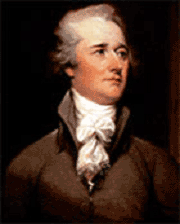
So, while the question of the day is about our national debt, and whether or not the GOP is bluffing about be willing to default, if I could conjure up just one of those Founding Fathers, I would want to hear what Hamilton had to say. Because if there could be such a person as the patron saint of the national debt, Hamilton is the man. He believed in a national debt. More importantly, he believed in timely, reliable payment of that debt. That last point is crucial; in fact, Hamilton actually advocated having a national debt just so that the government would need to make timely, reliable payments. Long before there were any guitar-playing pirate-waiters to make the point, Hamilton preached the value of a solid credit rating.
Hamilton knew that, whether they like it or not, governments sometimes have to borrow money. Emergencies happen, mainly unexpected wars when the country would need to quickly raise, train, and equip a larger army than it could afford to maintain permanently.1 The kings of Europe had found themselves borrowing money from banks for centuries and the US would be no different. It couldn't be helped.
What could be helped, however, was the rate of interest that the government would need to pay when it did borrow. Governments needed a good credit rating at least as much as merchants did. Hamilton had closely watched how the British government operated and was deeply impressed. The British borrowed constantly, repaid promptly, and by proving itself the pinnacle of safety, could borrow at the lowest possible rates. Hamilton had come away deeply impressed with England's ability to leverage money and, as the first Treasurer of the United State, he wanted his new country to do the same.
To do so, however, was going to require a hard-core sales job. The Continental Congress had borrowed outrageous sums of money financing the War of Independence, still owed soldiers their back pay, and was hard-pressed figuring out how to pay off everyone they owed. Millions of dollars in loans were owed to private individuals, but many of those people were not the original lenders. Over the years, as the nation's poor financial standing became increasingly apparent, many people had sold their securities to speculators, at a substantial discount (often as low as 15% of face value). To many traditionalists in Congress, men who approached financial matters from a moral perspective, it stuck in the craw to simply pay the current owner full value. Hard-working, patriotic Farmer Brown, who had risked his scarce capital to aid the struggling Revolution when the outcome was uncertain, would never get more than his 15¢ on the dollar. The sharp speculator who bought the loan from him would succeed in making a killing off Mr. Brown's distress.
Hamilton did not say, “Morality be damned, we have bigger fish to fry,” but that is the gist of his 1790 Report on Public Credit. At all costs, the United States must demonstrate good faith in paying its debts. "Credit rating,” although the term hadn't been coined yet, but the concept is foundational to all of Hamilton's policies. The people with money should be willing to lend it to the government. No, they should be eager to lend money to the government. They should be so certain that their investment is rock-solidly safe that they will lend at the lowest possible rates. Anything else, any policies that shake the confidence of investors in the reliability of the Treasury, will end up increasing costs, squandering treasure, and draining investments. Everyone loses, both as individuals and as the Public.
But why was it necessary that the current holder get the full payment, and the original purchaser nothing beyond what he had sold the bond for? Hamilton made a feeble effort to defend the speculators on moral grounds, arguing that he too had risked his money on an uncertain outcome and demonstrated his faith in the nation. Given the way government officials were moving to profit off a scheme that looked less and less risky,2 it was an unconvincing argument. Hamilton may have advanced it only half-heartedly anyway, since it was beside the point. Again, he was looking to the future and the future he wanted was one where investors not only could loan with complete safety, but could sell their bonds at full value anytime they needed to. The bonds would be easily traded because the purchaser would know that he could redeem it at full value. With that kind of value, a government loan would be as good as money. It would be money, for all practical purposes, and those practical purposes were uppermost in Hamilton's mind.
Specie, that is, gold and silver coin – the original cold, hard cash – was scarce in North America and hard to increase without discovering more metal. A growing economy needs a more flexible money supply and rock solid government bonds would fit the bill nicely. If money is more plentiful, it can be borrowed more cheaply, to the benefit of everyone attempting a profit-making venture. Settlers could purchase homesteads; merchants could fill ships with goods. Again, everyone wins.
A solid, reliable national debt was an essential foundation to it all. It meant cheaper borrowing for the government, and ultimately lower taxes to pay for it. Entrepreneurs would have access to cheaper money, too, removing an impediment to trade and development. Hamilton was the great advocate of capitalist development, but it all depended on a government that was scrupulous about meeting its obligations.
No doubt Hamilton would have abhorred the way we spend tax money; I can't imagine him approving of Social Security or Medicare. But would he have been willing to gamble the nation's credit rating, even to eliminate the evils of social spending and high taxes?3 Perhaps, if he had to choose between modern levels of government spending or toying with default, he would tell Madison to move over and also drink himself to death.
_________________________________________________
1. If I had to list the number of ways in which the United States departs from its founding ideals, the modern military would be at the top of the list. A large standing army, it was believed, would almost inevitably be used to control the public; it would tempt Presidents to seek glory in foreign adventures; and if neither of those happened, it would still be an enormous financial burden. Of the three, only the first danger has failed to emerge. On the other hand, we've so militarized our police forces that it hardly makes a difference.
2. Several Congressmen, and at least one Treasury employee close to Hamilton (although apparently not Hamilton himself) were sending agents scouring the country for loans to buy up before word got out and the price began to rise. Such insider trading is, of course, illegal today.
3. High to him; current tax collection is, overall, a bit low compared to late 20th Century norms.
Thursday, June 2, 2011
Alexander Hamilton, borrower and taxer
Tuesday, September 21, 2010
Those poor rich
Via Paul Krugman, I became acquainted with this post by J. Bradford DeLong over the travails of being rich in America. A certain professor of law at the University of Chicago and his physician wife probably pul in half a million dollars a year between the two of them, but he presents himself as just a poor working stiff, being taxed to death and barely scraping by. The problem? DeLong probably has it right: our Prof. X is trying to keep up with the megamillionaire Joneses, which puts a strain even on his resources. The Joneses can afford everything and more besides; Prof. X can only afford everything, and then only if he budgets carefully. What's a poor millionaire to do?
It's the basis of our economic problems today. This country spent the last eight years with an economic policy designed solely to gratify X and the Joneses; now that the bubble has burst, guess who expects to be last in line to pay for the damage? Ah, that would be Prof. X and the Joneses.
Really, I don't mind that people are rich. Prof. X and his wife have certainly worked harder than I have and I don't begrudge them their wealth. But at the same time to be such whiners! It's ... well, let's remain civil and just call it unseemly.
Saturday, March 20, 2010
Advertising v. royalties, QED
So are copyright owners harmed or helped when their material gets uploaded to YouTube? Are they being deprived of well-deserved royalties, or does the exposure count as free advertising that ultimately benefits them beyond any fees they could have realistically commanded?
The recently-released documents regarding Viacom's lawsuit against Google would seem to dispose of that question. It appears that even as Viacom was suing Google over unauthorized uploads, they were aggressively using YouTube as an indispensable marketing tool. The word-of-the-moment is "viral," the geometric expansion of attention as YouTube clips get linked from blogs, which get linked from more blogs, etc., until it's so famous that you can get a symphony orchestra to accompany a cat on the piano. Who, with anything to sell, wouldn't kill for that kind of fame?
What Viacom did (and it's surely a widespread practice) was not only post videos to YouTube, but go to great lengths to pretend that the clips were uploaded without authorization, or had even been stolen. They had third parties use untraceable email accounts, or reduced the quality to make it appear that they had been surreptitiously acquired, to disguise their advertising campaign as grassroots enthusiasm. Google charges that Viacom's smoke screen was so effective that they frequently lost track themselves, demanding their own clips be removed and later asking for reinstatement.
Google argues this as proof that they can't possibly keep track of authorized v. unauthorized uploads, if Viacom can't keep track of their own work. We'll see how that works out as a legal argument, but I'm more interested in the economic reality it indicates. As with radio play, free advertising benefits the bottom line far more than does trying to squeeze every last dime of performance royalties. At least, Viacom thinks so and they probably know their business.
Tuesday, July 14, 2009
IP and OLD technology meeting a changed culture
James asked for a post on the pending legislation that would require radio stations to compensate performers for playing their music on the air. So here goes.
The crux of the issue is this: when a radio station broadcasts a song, they have to pay royalties. But those royalties are due only to the composer of the song, not the performer. I'm not sure entirely why, other than that this arrangement dates back to the early 1920's when it was more common to identify a song by the composer than by the performer. Few composers would ever sing their own tunes and, for example, a Gershwin tune would remain a Gershwin tune regardless of who sang it. The notion of a "cover," have to acknowledge the fact that you're not the first to sing this song, would have generally been a redundancy.*
Well, times have changed and people care more about who sang the song than they do about who wrote it (if they're not the same person). A lot of folk won't recognize the names Jerry Lieber and Mike Stoller, but they can't help but think of Elvis Presley if they hear "Hound Dog" (most won't know that he didn't sing the real lyrics, either). Does it make a difference to heavy metal fans whether "You've Got Another Thing Comin'" is performed by Judas Priest or Pat Boone? You better believe it. Performers have eclipsed composers in the public's mind when they think of musical creativity.
So, if radio stations have to pay the composers when they broadcast music, why shouldn't they have to pay performers, too? Indeed, why not? I can't think of any good reason at all.**
Of course, the broadcasters can think up one really good reason why they don't want to, and plenty of weaker reasons why they shouldn't. To my mind, almost none of them fly.
First off, let's dispense with the BS about royalty fees representing a "tax." Royalties aren't taxes; people just hate the word more. That's just faster-than-78-rpm spin.
Nor will it drive radio stations out of business, or force them all to become talk radio stations (surely that market is already saturated!). We've heard it all before, every time the minimum wage goes up or automobile fuel efficiency standards are raised. "Can't be done! We'll all go out of business!" Nonsense. Remember how you used to see McDonald's and Burger King on every street corner, until they raised the minimum wage in 1993? And now you just can't find a fast food res - yeah, right.
You have to try to pass the cost on to your customers, but so do all your competitors. Unless the customers stop patronizing all of you, they end up paying the cost and everything goes on as before. Unless advertisers desert radio altogether, they'll just have to make their contribution to paying those royalties.***
The broadcasters do have one true argument. It's not really a legal argument, but they simply point out how much musicians benefit from having their music on the radio. And indeed they do. The payola scandals of the 1950's prove it - it was considered cheating for a record label to pay the radio stations to play certain artists. This wouldn't make any sense if they thought of that broadcast as a rip-off, but is perfectly sensible if they viewed it as advertising that boosted their overall revenue. Follow the money, if you want to know what they really believe.
Here's my take. Demanding revenues for the performers is perfectly fair and justified. However, it might be short sighted, especially if the fees are too hefty. So let's do this: let's let someone muscular, like Clear Channel, refuse to broadcast any music unless the performers pay for the advertisement. The market can be the referee and we'll see who really had whom by the balls all along.
[PS. The ringtone post was already getting long, or I would have discussed the performance-as-advertising aspect of that case. There should certainly be some awareness that selling ringtones has increased the market for popular music, to the artists' advantage. They deserve their cut, but trying to milk it that hard just shows a certain lack of respect for how little they directly contributed to expanding their own market.]
[PPS. It occurs to me (soemtime later) that composers for theater still enjoy preeminence over the performers. For example, Andrew Lloyd Weber enjoys a tighter association with his music more than any singer ever will, not even Sarah Brightman. I presume this reflects the difference between a transitory stage performance vs. the "imperishable" recorded performance.]
_____________________
* This may have much to do with the relative infancy of the recording business, too. In the age of live music, the performance was transitory and only the composition could have any permanence.
** In fact, internet radio - under more recent legislation - is already doing just that and would like to see the playing field leveled.
*** The broadcasters do point out that advertising receipts are down, but that can mean one of only two things: everything will be fine once the economy improves, or else radio is a failing industry anyway. Either way, special protections don't make long term sense.
Thursday, June 4, 2009
Is this why we buy health insurance?
Medical bills underlie 60 percent of U.S. bankruptcies
Harvard researchers surveyed some 2000 people who filed for bankruptcy in 2007. Their findings:
While only 29 percent directly blamed medical bills for their bankruptcy, 62 percent had medical bills that totaled more than 10 percent of family income, said an illness was responsible, had lost income due to illness or some other medical factor.
Even more shocking is the fact that 78% of these - or almost half of all bankruptcy filings - involved people who had health insurance. These were, in the main, middle class Americans with decent jobs and health insurance, yet a severe illness still throws them into economic distress. Part of the problem, as the report notes, is that too often you're only allowed to buy health insurance if you don't ask for health care:
"Nationally, a quarter of firms cancel coverage immediately when an employee suffers a disabling illness; another quarter do so within a year," the report reads.
And once you've lost it, good luck trying to ever get insurance again with a preexisting condition. So what good is health insurance? Hard to tell from the newspaper accounts of this study and, from the description of the method, I'm not sure this study adequately addresses the question. The key stat would be the proportion of insured families declaring bankruptcy v. the uninsured and I don't think the statistics are here to determine that. I don't find the study available yet at the American Journal of Medicine, but it will be worth taking a closer look at.
Edit: I neglected to point out that this data is from 2007, before the current economic troubles. This situation must be far worse right now.
Labels:
economics,
medicine,
public health


Wednesday, March 25, 2009
Left Hand, meet Right Hand. Right, Left.
At Worldview Times, Brannon Howse is railing against Obama's secret plan to advance socialism in the United States.
Meanwhile, over at Worldview Times, Stephen Kovaka gives us examples of economic "sin":
At the same time, ownership of the major sources of real wealth (land, buildings, farms, mines, factories) is being progressively concentrated in the hands of a tiny minority, a one-in-a-million Superclass.
I think I heard about this, maybe from some guy named Marx ....
It is God's opinion that economic health requires two things above all: debt must be liquidated regularly, and the snowballing accumulation of wealth by the few must be limited. When these two tendencies are unchecked, they eventually destroy the society in which they grow.
At which point, Kovaka* recommends the system advanced in Deuteronomy, where all debts are simply canceled - by law - every seven years. Apparently, nothing he's read recently would suggest that uncollectable debts pose problems for an economy.
So "No" to socialism, but we'll have the government cancel contracts at regular intervals and intervene to prevent the accumulation of wealth. Got it.
__________________
* In fairness to Kovaka, he's not advocating communism -- communal ownership of all resources. He just wants to ensure that ownership is widely distributed. He probably wouldn't say the government ought to cause this, but I don't know how else you would do it.
Wednesday, March 11, 2009
Wal-Mart enters the med-tech field
Bet you didn't see this coming: Wal-Mart Plans to Market Digital Health Records System
EHR - electronic health records - offer a way to improve health care and hospital efficiency by allowing easier access to patient records and easier sharing of critical information between different offices. The problem is that the systems are expensive, so while large hospitals may be using EHR, your private physician probably isn't. Which means, say, if you go to the hospital, your regular doctor can't easily give another doctor your file and all that potentially helpful information it contains. Enter Wal-Mart, who aims to make EHR affordable for the individual doctor or a small office.
“We’re a high-volume, low-cost company,” said Marcus Osborne, senior director for health care business development at Wal-Mart. “And I would argue that mentality is sorely lacking in the health care industry.”
Truer words were never spoken.
Labels:
economics,
medicine,
technology
Friday, January 23, 2009
University of California Libraries, Springer Strike Open Access Deal
Under the agreement, UC-affiliated authors accepted for publication in a Springer journal will be published using Springer’s Open Choice program, offering “full and immediate open access,” with per-article charges factored into the cost of the overall license. The cost of the license was not released, however, the standard Open Choice author fee is $3000. In addition, “final published articles” will also be deposited in CDL’s eScholarship Repository.
Not mentioned in the article is that Springer's Open Choice allows authors to retain copyright to their article, but requiring them to agree to a Creative Commons Attribution-Noncommercial License. Under traditional publishing, the author signs away all of his rights over to his publisher, most of which are charging ever-growing fortunes for subscriptions to that work. Libraries, as you might guess, are very intrigued by the prospects of open access publishing.
Labels:
commerce,
economics,
intellectual property,
scholarship
Friday, October 31, 2008
Oh to be ... irony-free
Pharyngula points us toward this image:
Jesus People Pray That False Idol Will Save God’s Economy
If you can't afford a golden calf these days, the bronze bull on Wall Street will have to do.

Sunday, October 26, 2008
Those wild and crazy MBA's
Wildcats gone wild
DRUNK MBA STUDENTS
Of course, it would be pure snark to compare this party with Wall Street under Republican government, so I'm not going to d-- oops, too late.

Monday, October 20, 2008
Keeping good books
Via The Devil's Archivist comes this perspective on our economic woes:
Records-level view of the financial crisis (Part 1), and
Records-level view of the financial crisis (Part 2)
In working as an information and document auditor I was in position to witness the convergence of the “buy-now-pay-later” and “quantity-over-quality” mentalities indicative of the mortgage industry boom and bust. I’ve mentioned this before, but you can tell a lot about people’s motivations through the records they create. Though most of the records, files, and groupings were completely legitimate and probably have happy endings awaiting somewhere, one with my job couldn’t help but notice a great deal of the haste, sloppiness, and underhandedness that characterizes the mess in general.
This is where the sub-prime phenomena started to become a problem, simply because if broker’s chose to, they could fudge the documentation process for the scads of people willing to walk into situations they couldn’t afford. No amount of oversight was able to detect the subtle ways that companies met recordkeeping requirements without really thinking of larger consequences beyond the law. And at all levels - from broker to funder, to wholesaler, to other wholesaler, to final buyer - there was this notion that you could pass the buck and that someone else would be responsible for collecting the final bill.
Having worked in accounting (sort of), I know that people hate all those pesky rules and record-keeping requirements that slow things down. And I also know that when you make it easy to do things, a lot of things get done that ought not to have. It's really hard to work out a scheme where only the good activities are facilitated.
Friday, October 3, 2008
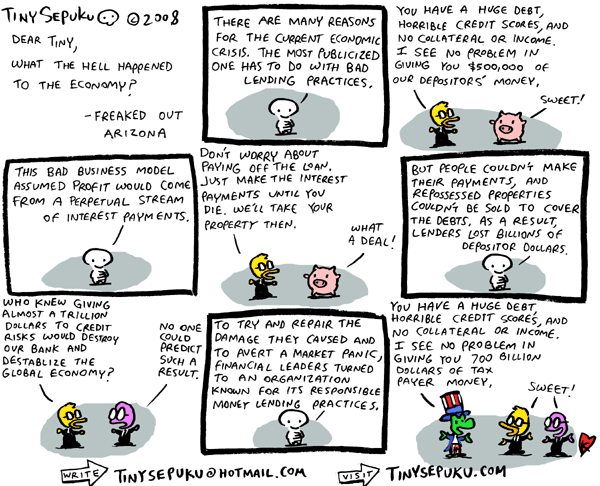
The financial crisis
There's an error, here, though. The government isn't lending any money - it's giving it away. Specifically, it's going to give away perfectly good money purchasing securities that no one else on earth wants at any price. I still wonder why loans are off the table? Why does all this money have to go to lending institutions in a form that will never require any of it to be paid back? If restoring liquidity is the goal, why can't we make the loans that are required to keep the financial world functioning, allow the weakest lenders start to fail, and allow the others to strengthen their position by purchasing the better paper at fire-sale prices?
Could it be that the people running the show think their primary responsibility is to guarantee investments, rather than guaranteeing the functioning of the economy?
(Thanks to James for the link)
Saturday, September 27, 2008

Wednesday, September 24, 2008
$700,000,000,000 grant request
Fred Clark at Slacktivist is outraged at Treasury Secretary Paulson's request for lots of money + lots of discretion - any oversight at all. Well, many people are, but I especially enjoyed Clark's slant on the issue:
I'm not usually in a position to say that I have more experience, knowledge and know-how than Ben Bernanke, but he really should've talked to somebody like me before heading to Capitol Hill yesterday to help Treasury Secretary Henry Paulson present a three-page memo asking for $700,000,000,000 of the public's money.
Three pages. Seriously.
... snip ...
[W]e wrote a lot of grants. And the thing is that every one of those grants was longer, more detailed and better documented than the sorry excuse for a memo that Paulson threw together to request $700 billion from the public coffers. It means your $15,000 grant application gets turned down. Why? Because $15,000 is a lot of money, and if you're going to ask someone to hand over that kind of cash, then you're going to have to do your homework. You're going to have to explain, in detail, what the money is for, where and when it's going to be spent. You're going to have to explain how you intend to report back, with detailed documentation, after the money is spent. And you're probably going to have to describe a detailed plan ensuring that you won't need to come back six months later to ask for another $15,000 for exactly the same thing.
Fail to provide that kind of documentation and detail and your grant application will be rejected. Not only that, but you'll be lucky if you're ever allowed to come back and re-apply with the same foundation.
Clark helpfully provides this link:

Labels:
economics,
government
Wednesday, September 17, 2008

Friday, August 8, 2008

Tuesday, July 29, 2008
Supply side fails again
White House Predicts $482 Billion Deficit

Suggesting, once again, that we've been on the left-hand side of the Laffer Curve all along. In fairness, though, the graphic does demonstrate that the projected deficits are record-setting only in absolute dollars, but not as a fraction of total GDP.
Labels:
economics
Monday, July 28, 2008
Wednesday, May 28, 2008
Correct response to rising gas prices
As gas goes up, driving goes down
Demand goes up; supply stays level; price goes up; demand goes down - finally. What $3.00/gallon couldn't do, $4.00/gallon has. Despite the bite it puts on my own finances, I've been wanting this for years.
Labels:
economics
