
Showing posts with label politics. Show all posts
Showing posts with label politics. Show all posts
Sunday, September 18, 2011

Wednesday, June 8, 2011
Knowin' my history ....
In the wake of Sarah Palin's defiant defense of her description of Paul Revere's ride, a lawyerly defense that she certainly must have needed explained to her after her sycophants dreamed it up for her, I'm trying to imagine her book report on George Washington. I picture it going something like this:
He who chopped down those cherry trees so that we could have homes and towns and, um, making sure while he's standing in that boat fathering our country that, uh, we're not going to lie about defending free enterprise and we're going to develop our country.
Makes as much sense as her comments on Revere, I'm afraid, except that the cherry tree story isn't at all factual. Doesn't matter; neither was Palin's portrayal of Paul Revere. Oh, sure, if you tear her paragraph limb from limb, you could overlay each part onto an accurate version of the event, but that's not historical knowledge. Poor students do this all the time and anyone who's taught history has seen it in exam booklets over and over: disconnected facts dropped almost randomly on the page, with no sensible connection between them, which read like a 2-year-old playing with a jigsaw puzzle. It's simply not possible for someone with any adequate understanding of the night of April 18, 1775, to have uttered that phrase.
Palin is that student who sat in the back of the class without listening, absorbing a few scraps of information without understanding any of it. She knows Revere rode a horse, she knows it was during the Revolution and that the British were the enemy, she's been told something about bells being rung in warning, and she even knows that it somehow connects to the famous "Shot Heard 'Round the World," although she doesn't know how. And she hurriedly assembles these random facts and comes up with a mental image that's completely wrong: Paul Revere riding through the streets of Boston ringing bells and firing warning shots.
As the saying goes, historians never miss a chance to miss a chance to educate the public on historical knowledge. It's depressing to see some historians, however reluctantly, declare that if her isolated factoids aren't entirely bogus, than her whole story has to be considered historically accurate. It does not, any more than a NAPA store is an automobile. That's why history exams include essay questions, where you can't make the lucky guess that might win on Jeapordy! You have to show you understand what your facts mean. By letting Palin's comments pass for "historically accurate," the whole concept of historical understanding gets short-changed.
Thursday, June 2, 2011
Alexander Hamilton, borrower and taxer
Dragooning the Founding Fathers to fight contemporary political battles is a time-honored tradition. Without a doubt, if Washington, Jefferson, and Adams were all here, they would ... well, they'd agree with me and take my side on every question. And since their word is Holy Writ, that proves I'm right. About everything,
Okay, not really, but I do sometimes find myself wondering what the FF's would think if they could suddenly be transported from their day to ours. I tend to imagine them stumbling around dazed for a few days, loading up on hard liquor, and then, when that runs out, quietly going off to kill themselves, James Madison perhaps muttering darkly “I told you it would never last.” Only Alexander Hamilton, I suspect, would recover from the dizzying shock and slowly come to think, “Hey! It worked! Commerce! Wealth! Power! Oh, it's everything I wanted!”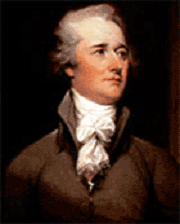 Hamilton, as the man most responsible for putting the United States on a sound, capitalist-friendly fiscal footing, has long been a favorite of conservatives. A historian whom I can't recall once noted that one can trace the relative ebb and flow of conservatism and liberalism by counting the rise and fall in biographies of Alexander Hamilton and Thomas Jefferson. It's no coincidence that one popular biography of Hamilton was penned by a senior editor of National Review.
So, while the question of the day is about our national debt, and whether or not the GOP is bluffing about be willing to default, if I could conjure up just one of those Founding Fathers, I would want to hear what Hamilton had to say. Because if there could be such a person as the patron saint of the national debt, Hamilton is the man. He believed in a national debt. More importantly, he believed in timely, reliable payment of that debt. That last point is crucial; in fact, Hamilton actually advocated having a national debt just so that the government would need to make timely, reliable payments. Long before there were any guitar-playing pirate-waiters to make the point, Hamilton preached the value of a solid credit rating.
Hamilton knew that, whether they like it or not, governments sometimes have to borrow money. Emergencies happen, mainly unexpected wars when the country would need to quickly raise, train, and equip a larger army than it could afford to maintain permanently.1 The kings of Europe had found themselves borrowing money from banks for centuries and the US would be no different. It couldn't be helped.
What could be helped, however, was the rate of interest that the government would need to pay when it did borrow. Governments needed a good credit rating at least as much as merchants did. Hamilton had closely watched how the British government operated and was deeply impressed. The British borrowed constantly, repaid promptly, and by proving itself the pinnacle of safety, could borrow at the lowest possible rates. Hamilton had come away deeply impressed with England's ability to leverage money and, as the first Treasurer of the United State, he wanted his new country to do the same.
To do so, however, was going to require a hard-core sales job. The Continental Congress had borrowed outrageous sums of money financing the War of Independence, still owed soldiers their back pay, and was hard-pressed figuring out how to pay off everyone they owed. Millions of dollars in loans were owed to private individuals, but many of those people were not the original lenders. Over the years, as the nation's poor financial standing became increasingly apparent, many people had sold their securities to speculators, at a substantial discount (often as low as 15% of face value). To many traditionalists in Congress, men who approached financial matters from a moral perspective, it stuck in the craw to simply pay the current owner full value. Hard-working, patriotic Farmer Brown, who had risked his scarce capital to aid the struggling Revolution when the outcome was uncertain, would never get more than his 15¢ on the dollar. The sharp speculator who bought the loan from him would succeed in making a killing off Mr. Brown's distress.
Hamilton did not say, “Morality be damned, we have bigger fish to fry,” but that is the gist of his 1790 Report on Public Credit. At all costs, the United States must demonstrate good faith in paying its debts. "Credit rating,” although the term hadn't been coined yet, but the concept is foundational to all of Hamilton's policies. The people with money should be willing to lend it to the government. No, they should be eager to lend money to the government. They should be so certain that their investment is rock-solidly safe that they will lend at the lowest possible rates. Anything else, any policies that shake the confidence of investors in the reliability of the Treasury, will end up increasing costs, squandering treasure, and draining investments. Everyone loses, both as individuals and as the Public.
But why was it necessary that the current holder get the full payment, and the original purchaser nothing beyond what he had sold the bond for? Hamilton made a feeble effort to defend the speculators on moral grounds, arguing that he too had risked his money on an uncertain outcome and demonstrated his faith in the nation. Given the way government officials were moving to profit off a scheme that looked less and less risky,2 it was an unconvincing argument. Hamilton may have advanced it only half-heartedly anyway, since it was beside the point. Again, he was looking to the future and the future he wanted was one where investors not only could loan with complete safety, but could sell their bonds at full value anytime they needed to. The bonds would be easily traded because the purchaser would know that he could redeem it at full value. With that kind of value, a government loan would be as good as money. It would be money, for all practical purposes, and those practical purposes were uppermost in Hamilton's mind.
Specie, that is, gold and silver coin – the original cold, hard cash – was scarce in North America and hard to increase without discovering more metal. A growing economy needs a more flexible money supply and rock solid government bonds would fit the bill nicely. If money is more plentiful, it can be borrowed more cheaply, to the benefit of everyone attempting a profit-making venture. Settlers could purchase homesteads; merchants could fill ships with goods. Again, everyone wins.
A solid, reliable national debt was an essential foundation to it all. It meant cheaper borrowing for the government, and ultimately lower taxes to pay for it. Entrepreneurs would have access to cheaper money, too, removing an impediment to trade and development. Hamilton was the great advocate of capitalist development, but it all depended on a government that was scrupulous about meeting its obligations.
No doubt Hamilton would have abhorred the way we spend tax money; I can't imagine him approving of Social Security or Medicare. But would he have been willing to gamble the nation's credit rating, even to eliminate the evils of social spending and high taxes?3 Perhaps, if he had to choose between modern levels of government spending or toying with default, he would tell Madison to move over and also drink himself to death.
_________________________________________________
1. If I had to list the number of ways in which the United States departs from its founding ideals, the modern military would be at the top of the list. A large standing army, it was believed, would almost inevitably be used to control the public; it would tempt Presidents to seek glory in foreign adventures; and if neither of those happened, it would still be an enormous financial burden. Of the three, only the first danger has failed to emerge. On the other hand, we've so militarized our police forces that it hardly makes a difference.
2. Several Congressmen, and at least one Treasury employee close to Hamilton (although apparently not Hamilton himself) were sending agents scouring the country for loans to buy up before word got out and the price began to rise. Such insider trading is, of course, illegal today.
3. High to him; current tax collection is, overall, a bit low compared to late 20th Century norms.
Friday, April 29, 2011
Friday photo
 Flag reflected in rain puddles. University of Michigan, April 2011.
How can you miss Oregon when it's been raining every day in Michigan for the last couple weeks? It seems like every day, anyway, although the National Weather Service may have statistics to prove otherwise. But rain is visually interesting, so I dawdled my way across campus the other day, trying out a few shots that featured the rain and its effect. This one came out ... not especially attractive, but interesting in its own way.
Freezing the flag's motion, and the ripples' motion, gives it an entirely different look than in real life. It's barely identifiable as a flag, but a touch of extra saturation brings out enough red to trigger recognition. The bricks are red, too, but reflect the overcast sky so strongly that they remain a particularly ugly shade of greenish-gray.
To my cynical eye, it almost looks like a pool of blood flowing across the bricks, which is not any effect I had in mind when I took the photo. Nor did I intend the flag to represent any political critique of our country. But now that the photo is there, it almost seems to have its own ideas on what it's going to mean. Or, to take more responsibility, my own mind doesn't reject the association of American flag + blood on the streets = some appropriate commentary. It's just too easy these days, with Americans now fighting in three different Middle Eastern countries where they too often can't tell what they're shooting at, and too often kill people who only want to be left alone. And supporting a few other countries where the rulers are celebrating spring by deliberately shooting down their own people in the streets.
I wish our flag didn't trigger those associations so easily. One of the more painful moments for me is to watch the Olympics or the World Cup and watch fans waving their nations' flags with joy and pride. I can cheer for our athletes, but it's hard for me to wave our flag; it's been coopted by the uglier nationalists in our midst, whose cry of "God Bless America!" always seem to carry the subtext, "(and no one else, unless they toe the line)." Most often, that phrase carries an overtone of belligerence, and too often the vocal tones are undeniably angry. While other nations have their ugly nationalists, too, I just don't get that impression of hostility when I hear hockey fans give a full-throated rendition of "O Canada", even if that sort of national consciousness surely must owe a lot to awareness of those noisy foreign neighbors.
As I said, I get jealous. I wish my flag triggered a more innocent kind of pride.
Labels:
photography,
politics


Monday, March 21, 2011
What Would You Do?
At Outside the Beltway, a cogent comment on how dictators will respond to our attack on Libya:
Libya didn't get nukes; now they're vulnerable to attack. That will be the take home message among strong men the world over.Indeed, there was hope by the Bush administration and amongst its allies eight-ish years ago that the US actions in Afghanistan and Iraq would prove to be a deterrent to states who might be contemplating such actions.
As history shows, it had the directly opposite effect on Iran, as it did not go without notice that Iraq was invaded to prevent a nuclear program ... and that the only member state of the “Axis of Evil” that no one seemed interested in invading was the one with nukes (i.e., North Korea). As such, the rational choice to procure a nuke PDQ was made.
In today's continuation of the World's Longest Book Review at slactivist, Fred Clark maintains that the authors can't even make a compelling disaster story out of Armageddon because they're incapable of asking, What if that was me? Ironically, our politicians are perfectly capable of creating a disaster story our of our foreign policy because they, too, are incapable of asking, What if that was me? How would I respond to make myself secure?
Empathy. It's not just for the wishy washy can't-we-all-just-get-along types. If you want to be a successful hard-headed realist, you need to cultivate it, also.
[Update: North Korea says the same]
Labels:
politics
Thursday, March 3, 2011
Thursday, January 27, 2011
Tuesday, November 16, 2010
Irony, or Why I don't take conservatives seriously, pt. DCCXIII
Republican Andy Harris, an anesthesiologist who defeated freshman Democrat Frank Kratovil on Maryland’s Eastern Shore, reacted incredulously when informed that federal law mandated that his government-subsidized health care policy would take effect on Feb. 1 – 28 days after his Jan. 3rd swearing-in.
(snip)
“Harris then asked if he could purchase insurance from the government to cover the gap,” added the aide, who was struck by the similarity to Harris’s request and the public option he denounced as a gateway to socialized medicine.
Understood properly, however, Mr. Harris isn't really being the hypocrite he appears to be. Conservative hostility to health care reform never rested on fiscal concerns. It all comes down to the most fundamental dichotomy of conservative thought: their self-image of themselves as responsible, hard-working producers v. lazy, irresponsible parasites (aka "liberals"). It's why Social Security and Medicare remain untouchable, while health care reform was frequently opposed on the grounds that it would offer benefits to illegal immigrants (surely the most trivial of concerns regarding the financing of health care reform).
Mr. Harris is hard working and responsible. He deserve health care, and he deserves it now. I won't quibble with that. I just wish he would consider that he might not be the only one.
Via The Daily Dish
Labels:
health care,
politics
Tuesday, October 26, 2010
Sunday, October 10, 2010
Saturday, September 25, 2010
Heroes in their own minds
Have you ever seen one of those adolescent males, maybe 20 years old, who loves The Matrix too much? He's the guy who has gotten it into his head that if he just drapes his too-skinny or too-pudgy body in a full-length leather coat ... why, then surely he looks just like Keanu Reeves and can date Carrie-Anne Moss. That was rather my impression of the GOP's new Pledge to America. Because it reeks of the same self-delusions as this guy:
Look, we all have our Walter Mitty moments, seeing ourselves as the protagonist of some heroic, secret fantasy. Most of us are smart enough to do what Mitty did - keep it secret. When you go public, like our dorky adolescent Neo's, you just look ridiculous.
So, regarding that Pledge. The one that -- betcha didn't see this coming -- promises to cut taxes, raise defense spending, protect Medicare, and balance the budget all at the same time; the one that promises to cut Congress's budget while simultaneously reviewing each and every regulation issued by the Executive Department; the one that shockingly reveals that government spending in nominal dollars has doubled since 1980*; the one which shamelessly claims that the Republicans balanced the budget in the 1990s. The one whose photographs portray an America which is 99.5% white.
That Pledge. The one which clumsily tries to evoke the Declaration of Independence by opening with:
America is an idea – an idea that free people can govern themselves, that government’s powers are derived from the consent of the governed, that each of us is endowed by their Creator with the unalienable rights to life, liberty, and the pursuit of happiness. America is the belief that any man or woman can – given economic, political, and religious liberty – advance themselves, their families, and the common good.
America is an inspiration to those who yearn to be free and have the ability and the dignity to determine their own destiny.
Whenever the agenda of government becomes destructive of these ends, it is the right of the people to institute a new governing agenda and set a different course.
Okay, so the GOP has no one who can write like Thomas Jefferson. Who does anymore? But "institute a new governing agenda and set a different course"? How do you get from the ringing challenge of "it is the Right of the People to alter or to abolish it, and to institute new Government” to the mewling "institute a new governing agenda"?
You get there by indulging your fantasies of 1775, even while recognizing that the comparison is just beyond ridiculous. Even for the people who can write the absurdities above (only a bare sample, I assure you), the Declaration is an embarrassment to them, because they simply are not oppressed the way their ancestors were.
Oh, they feel oppressed, no doubt about it. And they certainly do imagine themselves as modern day Sam Adamses and Paul Reveres, bravely standing up to tyranny. But when they begin to state the causes of their discontent, the truth is so embarrassing that they have to scramble and scratch for some formulation that won’t invite, no, demand ridicule.
The colonists famously rebelled against “taxation without representation.” Our GOP revolts against losing free and fair elections. They dream of themselves as heroic Sons of Liberty, bravely pledging their lives, their fortunes, and their sacred honor against a tyrannical government; in reality, they whine because they don’t get their way every time. But they can't say that out lod. So they tell this lie instead:
An arrogant and out-of-touch government of self-appointed elites makes decisions, issues mandates, and enacts laws without accepting or requesting the input of the many.
Alas, that mouse doesn't roar. Not one member of Congress is self-appointed. Not a single one can maintain his seat against the will of the majority. That's why the Pledge uses the word many: because saying majority would give the game away. The truth is that they not only have the right to institute a new governing agenda, they also have the means to do so. All they have to do is win an election. Last time they lost; this time out they’re likely to win. That’s democracy, not tyranny.
The GOP and the Tea Partiers don't share the grievances of the colonial rebels -- they get to vote for the people who tax them. The Sons of Liberty didn’t have representatives in Parliament; if they didn't like the British government which ruled them, the SoL were SOL. The Tea Partiers are just Sore Losers. Which is why, when they try to dress themselves as heroes, they look like adolescent dorks instead.
__________________________________
*That works out to 2.5% growth per year, which compares well with the average inflation rate of 3.3% over the same period (calculated from the Bureau of Labor Statistics's CPI Inflation Calcualtor)
Thursday, September 23, 2010
Home is where they have to take you in
The official Montana GOP platform states:
We support the clear will of the people of Montana expressed by legislation to keep homosexual acts illegal.
Which had drawn a bit of attention, needless to say. But I love this bit from state Senator John Brueggeman:
"I looked at that and said, 'You've got to be kidding me.' Should it get taken out? Absolutely. Does anybody think we should be arresting homosexual people? If you take that stand, you really probably shouldn't be in the Republican Party."
And I wonder, why? Where else would they go?
Labels:
politics
Monday, August 2, 2010
Big Rock Candy Mountain
I composed these lyrics a few years ago, but since Republicans make such a virtue of their inability to learn, the words still fit.*
Big Rock Candy Mountain (Republican Version)
On a summer day in the month of May
I met a Republican drivin'.
He was going down from his hometown
‘Cause the riffraff were arrivin'.
As he drove along he sang a song
Of a land of milk and honey,
Where a man can’t stay a single day
If he don’t have any money.
In the Big Rock Candy Mountain you never pay no tax
And all the schemes of government get stopped right in their tracks.
The market keeps on rising and the bubble never pops.
The stocks stay high and the wages low;
Your portfolio just grows and grows
In the Big Rock Candy Mountain.
In the Big Rock Candy Mountain the poor stay out of sight.
They just show up for work each day and disappear at night.
They never ask for raises, short hours, or minimum wage.
They’ll do their task and never ask
For a bigger share than you care to spare
In the Big Rock Candy Mountain.
In the Big Rock Candy Mountain you always have a maid
Who’s working far too hard to pause and say she's underpaid.
Your nanny works on weekends and your gardener takes no breaks.
They’re never seen, but your house is clean;
It looks just like a picture in a magazine
In the Big Rock Candy Mountain.
In the Big Rock Candy Mountain they attend church every day.
There’s a Bible in each classroom and they stop each hour to pray.
They don’t allow no atheists and the Darwinists get hung.
They'll slit the wrists of the scientists
Who deny the Earth its recent birth
In the Big Rock Candy Mountain.
In the Big Rock Candy Mountain there’s a cop by every door,
And every prison cell is full and they’re willing to build more.
You’ll never see treehuggers, no hippies, French, or gays.
Oh, I want to be where they look like me,
Where the weirdoes know that they shouldn’t go,
In the Big Rock Candy Mountain.
___________________________
*Admittedly, the French have fallen off the radar lately.
Thursday, July 1, 2010
WWJD?
Here's a fun web site that puts the words of prominent conservatives into the mouth of their hero, Jesus. You can hardly tell the difference....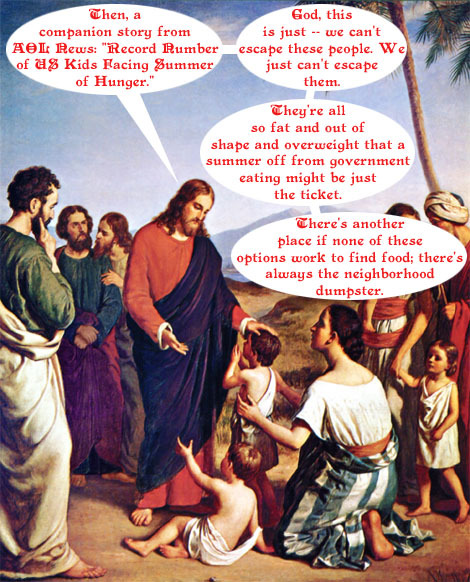
Via Why Evolution Is True
Tuesday, June 8, 2010
How to be presidential
The press is complaining that President Obama is too calm. They want him to spend less time talking to experts, studying the issue, and trying to find solutions - and more time acting out his anger for the public.
Don't we have Republicans for that?
Labels:
politics
Tuesday, April 27, 2010
Why government has betrayed Us
Here's an interesting survey from the University of Washington. Would you believe that those anti-government Tea Partiers are a bit, um , selective about when they oppose government action and when they approve it?*
Compared to TP opponents, as well as middle-of-the-road respondents, Tea Partiers are much more likely to favor wiretapping, indefinite imprisonment without trial, and racial profiling. Extraordinary police powers? Government good!
On the other hand, they're less likely to agree that "society should do whatever is necessary to ensure equal opportunity in this country," far more likely to agree that "We have gone too far in pushing equal rights in this country," and very unlikely to agree that "We don't give everyone an equal chance in this country." Enforce the 14th Amendment? Government bad!
But the strongest disagreement with the rest of the world shows up in their contempt for Barack Obama. He has no virtues. Few of them can even acknowledge that the President is knowledgeable and intelligent - but maybe that's because Fox News didn't let them see Obama single-handedly outclass the collective brainpower of an entire roomful of Republican Congressmen.**
So there's your Tea Party for you. Equality is bad, especially when it results in a black President. You're supposed to spy upon and imprison the people who scare me, not help them vote and work and get access to health care. Stinkin' traitors, letting Them run free in my country. We're gonna load up the RV and go tell that dang Congress how downtrodden we are.
______________________
* Rhetorical question. Of course I'd believe it.
** Give Obama credit for being bright, but let's face it - outwitting an entire roomful of legislators ought not to be possible. If Kobe Bryant goes 1 on 5, even he only wins if the five opponents are punks.
Friday, April 23, 2010
On critical thinking
Oh, for Goodness Sake showed me Anderson Cooper's wonderful interview of Arizona State Representative Cecil Ash. Ash is one of the proponents of the birther bill, which states that the Federal Elections Commission has no authority over a federal election in Arizona and presidential candidates need to present their birth certificates to the Arizona Secretary of State for approval.
Ash insists this is necessary, because there are all these rumors, don'cha know, and they have to be taken seriously. And every time Cooper* prods him with evidence that the rumors are unfounded, he responds with, "I don't know about that; you can't believe everything on the internet." A tour-de-force of the Will to Ignorance.
__________________________
* Kudos to Cooper, btw, for responding to a moron as he deserves. Very rare in the media today.
Friday, April 9, 2010
Protesting taxes
T.H. Breen, a prominent historian of early America, has an interesting column in the Washington Post, in which he contrasts today's Tea Party protests with their professed models, the colonial rebels against Great Britain:
When Americans protest, whether it is today's Tea Party members or Vietnam Veterans Against the War being arrested on Lexington Green in 1971, they often lay claim to the ordinary patriots of the Revolution. The impulse of many protesters has been to assert kinship with the middling Americans who came forward to resist British imperial power.
Breen bears no love for the Tea Partiers, but wants to retain their heroes as his heroes. In doing so, he goes a little too far in defending their rebellion:
[T]he colonists did not protest taxation. To be clear: They protested against taxation without representation, an entirely different matter. During the summer of 1774, when Parliament punished the city of Boston for the destruction of the East India Company's tea, people throughout Massachusetts Bay continued to pay taxes to the colonial government. At this chaotic moment, rather than keep their money, colonists voted in town after town to no longer transfer tax revenue to Harrison Gray, a treasurer of loyalist sympathies, but instead to send "moneys which they then had, or in future might have in their hands, belonging to the Province" to one Henry Gardner. Anyone who misses this point risks missing the fact that ordinary American patriots accepted the legitimate burdens of supporting a government in which they enjoyed genuine representation.
What Breen says is true, but what he doesn't say is also true: in the first decade after the end of the war, Americans did take up arms against taxes themselves - taxes that were levied by legal entities, to which the taxed parties had elected representatives of their own choosing.
Struggling with the debt it had racked up, Massachusetts levied such heavy taxes1 that, in 1785-86, 1500 farmers2 created an ad hoc army under one Daniel Shays and used force to shut down the local courts, so that those courts couldn't carry out foreclosures for tax delinquency. Although Shays was a veteran of the Revolution, his men were more angry than brave and they were easily routed by a small militia force. Still, the incident scared the hell out of the ruling classes and helped persuade them to get off their duffs and do something about their ineffective national government, a government that couldn't raise revenue to either reduce the debt or pay for an army to put down rebellion. A few years later, a brand new federal Constitution was born.
In 1794, another group of farmers also revolted, this time in Pennsylvania. Again, a large group of men with guns shut down the courts and attacked tax collectors, but this time were overawed by a 13,000 man force led by
_____________________
1 Exactly as Britain had first levied the Stamp Act to deal with its debt from the Seven Years War. Kind of ironic, you might say.
2 Taxes were levied primarily on land, so farmers bore a much heavier burden than did city-dwelling merchants and mechanics.
3 Farmers were turning their corn into whiskey because it was easier and cheaper to transport that way; as with land taxes, the tax on distilled liquors fell disproportionately on them.
Friday, March 19, 2010
Feeling let down
It all began with Hope, but I've lost my enthusiasm for our President. This morning was the last straw. Not only has his administration been no better on FOIA than Bush, but now this:
President Obama's NCAA bracket has No. 13 seed Siena beating No. 4 seed Purdue in the South Regional.
*Moan* The letdowns just keep coming.
Wednesday, March 17, 2010
Texas Board of Education Follies
Scott Stantis nails it pretty well, I'd say:
via Millard Filmore's Bathtub
Subscribe to:
Posts (Atom)
