Showing posts with label photography. Show all posts

Friday, October 21, 2011

Friday photo

Au Sable River, Huron National Forest, Michigan. October 2011.

Here's another photo from my Au Sable trip. I thought I should offer up a nice colorful-trees image, while we're still in autumn.

The raft is a replica wanigan, a floating kitchen and supply store for lumbermen who worked in the deep woods, far from the main camp. Up the hill from this spot is the Lumberman's Monument, a celebration of those 19th Century men who supplied the nation with timber and stripped the Michigan landscape of its native cover. As you can see from this older image, they were effective at their jobs. The statue today is surrounded by second-growth trees.

Friday, October 14, 2011

Friday photo

Grass stalks reflected in the Au Sable River. Huron National Forest, Michigan, October 2011.

I just loved the feeling of geometry here.

Tuesday, August 16, 2011

Fun with Photoshop

I missed the Indycar race Sunday. Hate to do that, but my sister-in-law was appearing in an excellent performance of "Singing in the Rain" and, if I skipped that, there wouldn't be any YouTube highlights to tell me what I missed.

What I did miss was a major executive-decision screwup: with 5 laps left and the cars running under caution due to rain, the race was restarted even though it was clearly still too wet to race safely. Unnecessary mayhem ensued and Will Power, never the shrinking violet, let Race Control know what he thought of their decision:


(And no, that wasn't ABC that put Power's fingers on a loop)

At iRacing, someone suggested that this was a great topic for Photoshop and I agree. Here are my submissions.

Will Power, the movie actor:


Will Power at the center of historic events:


Will Power vacations in Scotland:


More here


More. This is fun!


Friday, July 22, 2011

Friday photo

Swimmer. Adrian, Michigan, July 2011.

I took my camera to the Ohio-Michigan Summer Swim League meet in Adrian this week and this was my favorite shot of the day, with my brother's youngest daughter performing the breast butterfly stroke. It's a good action shot, one that manages to freeze the action without destroying the impression of motion.

I've done a modest amount of sports photography, mostly of amateur events, and it's amazing how many shots taken at the peak of the action don't make good action shots. Just freezing an instant (in this case, about 1/1000 of a second) usually catches the athlete in an awkward-looking moment, with an arm half-cocked, or the leg one-quarter lifted, or some such thing. If you read up about action photography, they'll tell you to look for the right moment, and give you some hints as to when that's likely to occur. For example, in basketball, the peak of a jump shot is likely to be the "right" moment.

But I haven't seen anyone discuss why, during the right moment, this instant looks right and the instant before just looks clumsy, awkward, and unnatural. I don't have the answer, either, but I suspect that there's something about finding a sort of peak of the motion while avoiding the middle. For example, a tennis player's serve would look good with the ball in the air and the player preparing for the smash, or on the follow-through. But the instant just before the ball is hit would likely appear clumsy and (paradoxically) more frozen, ruining the sense of action.

In the photo above, it seems to make all the difference that the swimmer is caught with arms fully extended and not, say, three-quarters extended. Just to throw out a hypothesis, I suspect that motion is generally seen as movement from point to point (or from position to position) and we like an image that conforms to the way we see it; that is, we want to see those destination points, not the instants in between. Arms fully extended, or arms swept all the way back, look good and action-packed -- but in between is less pleasing. What happens in between is too rapid for our eyes to see properly and looks unfamiliar when it's frozen at 1/1000 of a second.* Perhaps we just prefer those ever-so-slightly-slower moments that our eye can detect in real time, that remain recognizable when they're captured in a still photograph.

One more stroke of luck in this photo's favor: good sports photos need faces and emotion in them and the splash has just the proper break to show at least some of the face, the eyes especially. Even with the swim goggles, an impression of determination and concentration comes through.


_______________________________________
* Bearing in mind that cinema needs only 24 frames per second to give a convincing illusion of motion.

Friday, July 1, 2011

Friday photo

Rainbow over Hayden Valley. Yellowstone National Park, June 1995.

Rainbows. The only cheaper subject for a nature photographer is sunsets, and that only because they happen to you more frequently. You get especially spoiled living in the mountains, because unlike the Midwest, where the clouds may cover the entire sky for hours on end, a sharp end to the storm is likely to arrive while the rain is still falling. Also, thunderstorms are especially common in late afternoon and when the cloud's edge approaches, the sun is sinking down to the optimal level for creating rainbows (a 42° angle from sun to rainbow to observer).

As far as the mythology of rainbows goes, I'm mostly familiar with the Noah story, where God promises never again to destroy the Earth with a technique that could never have worked in the first place. You can read a quick summary of some alternative mythologies at the relevant Wikipedia article. I often wonder how much anyone took these stories seriously; after all, we all still know the myth of leprechaun's gold at the end of the rainbow, although people who believe it are probably as scarce today leprechauns. Were these stories ever for the adults, or were they always meant as children's entertainment?

Still, I was a bit surprised to learn how long ago people were trying to figure out how rainbows work, from a naturalistic framework. Based only on surviving writings, we can push it back at least as far as Aristotle in the 4th century BCE. It was probably easy enough to understand that the sunlight was being reflected back from water droplets in the air, since the rainbow always appears in the opposite direction from the sun and, in fact, you don't even need rain. The spray from a waterfall will do nicely. But the Greeks were also damned good with geometry, and Aristotle used these skills to explain how logical it was that that the rainbow should have such a perfect semicircular shape. He grasped that the light had to be reflected at a particular angle back to the observer and that the entire set of points that satisfy this condition would form a circle.*

Figuring out why their are colors is pretty tricky, but sometime around 1300 the Persian astronomer Kamāl al-Dīn al-Fārisī used a large, spherical globe filled with water to model a raindrop and worked out that the ray of light is refracted twice, once as it enters the droplet and again as it leaves, having bounced off the far interior wall. He eventually concluded that the white light was somehow being decomposed into the various colors, anticipating Isaac Newton's famous prism experiments in the 1680's


Traditionally, we divide a rainbow into seven colors, but those bands don't really exist and Roy G. Biv is as fictional as Cupid. The bending of the light is seamless and the change in colors ought to appear perfectly seamless as well. But we don't see color that way. We have three types of photoreceptor cone cells in our eyes that each respond to a different wavelength and what we see is a calculation based on those three inputs. Birds, reptiles, and amphibians, on the other hand, have four or five different types of cones and almost certainly can discriminate colors far better than we can. Set your monitor to 256 colors and take off your glasses - that's probably how a bird would feel if you were to suddenly give them human vision.


_________________________________________________
* The ground cuts off the bottom half of the circle, of course, but full circle rainbows can be seen from the air. I have a cousin who flew on helicopter gunships in Vietnam and tells me that he saw one. I could really envy him the experience, if it weren't for all that war and shooting and danger business that went along with it.

Friday, May 13, 2011

Friday photo

Pelicans on Yellowstone River. Yellowstone National Park, June 2005


One of the last photos I took in Yellowstone and one of my favorites (you'll probably need to click and enlarge it). I had just composed this scene of the sunset over the Yellowstone River -- the cheapest and easiest way to engage in nature photography, let's be honest here -- when three pelicans swooped in from the left. I saw them just in time to delay tripping the shutter* and waited until they entered the frame. Ah, and then one of them tired of the others' conversation or something, and decided to land in the river. What a stroke of fortune; the outstretched wings and the ripples from his feet breaking the water are just so much more dynamic than the river and sky, or even than the three birds in flight would have been.

Pelican flight is absolutely gorgeous and stately. They don't do aerobatics like the swallows that nest under the eaves of Lake Hotel. They don't flap frantically. They glide through the air as if on a tram, faster than hawks and eagles normally soar, more immune to buffeting breezes that bounce seagulls about. Once my sister and I were standing on the high bluff on the east side of LeHardy Rapids, looking down on the river, when a similar flight of three pelicans suddenly swooped into view below us. A video could never convey the effect; such serendipitous beauty can only be savored in the moment.

Which is to say, I hope you enjoy the photo. But it's not the same as being there.


____________________________________________________
* An unfortunate feature of digital cameras is that they take several seconds to save the digital file between each shot, unless you've set the camera to 'burst' mode. Landscapes don't usually move, even in a volcano like Yellowstone, so I didn't typically use burst mode.

Friday, May 6, 2011

Friday photo

Dirt road. Jackson County, Michigan, September 2005.


I don't know about you, but this looks nothing like Michigan to me. Even the foliage looks foreign, even though there's nothing in here that you can't see in southeast Michigan. Maybe it's the combination of dirt and hill; in the farm country where I grew up, unpaved roads tend to be gravel and flat, straight, and open to the sky.

For this shot, I timed it so that a car had just disappeared over the hill and its cloud of dust was not quite dispersed, giving the image a lonelier, remote feel .

Friday, April 29, 2011

Friday photo

Flag reflected in rain puddles. University of Michigan, April 2011.

How can you miss Oregon when it's been raining every day in Michigan for the last couple weeks? It seems like every day, anyway, although the National Weather Service may have statistics to prove otherwise. But rain is visually interesting, so I dawdled my way across campus the other day, trying out a few shots that featured the rain and its effect. This one came out ... not especially attractive, but interesting in its own way.

Freezing the flag's motion, and the ripples' motion, gives it an entirely different look than in real life. It's barely identifiable as a flag, but a touch of extra saturation brings out enough red to trigger recognition. The bricks are red, too, but reflect the overcast sky so strongly that they remain a particularly ugly shade of greenish-gray.

To my cynical eye, it almost looks like a pool of blood flowing across the bricks, which is not any effect I had in mind when I took the photo. Nor did I intend the flag to represent any political critique of our country. But now that the photo is there, it almost seems to have its own ideas on what it's going to mean. Or, to take more responsibility, my own mind doesn't reject the association of American flag + blood on the streets = some appropriate commentary. It's just too easy these days, with Americans now fighting in three different Middle Eastern countries where they too often can't tell what they're shooting at, and too often kill people who only want to be left alone. And supporting a few other countries where the rulers are celebrating spring by deliberately shooting down their own people in the streets.

I wish our flag didn't trigger those associations so easily. One of the more painful moments for me is to watch the Olympics or the World Cup and watch fans waving their nations' flags with joy and pride. I can cheer for our athletes, but it's hard for me to wave our flag; it's been coopted by the uglier nationalists in our midst, whose cry of "God Bless America!" always seem to carry the subtext, "(and no one else, unless they toe the line)." Most often, that phrase carries an overtone of belligerence, and too often the vocal tones are undeniably angry. While other nations have their ugly nationalists, too, I just don't get that impression of hostility when I hear hockey fans give a full-throated rendition of "O Canada", even if that sort of national consciousness surely must owe a lot to awareness of those noisy foreign neighbors.

As I said, I get jealous. I wish my flag triggered a more innocent kind of pride.

Friday, April 15, 2011

Friday photo

Sand Dune. Stovepipe Wells, Death Valley National Park, April 2002.

I made my one and so-far-only trip to Death Valley at the end of a winter season in 2002. It was late March, shading into April, and I was still acclimated to winter in the Northern Rockies. Shouldn't be too bad, I thought, since the average high in DV this time of year is around the mid-80's. I can do that.

I probably could have, but that isn't what I got. It was already as warm as June when I got there, topping out a few degrees into triple digits. And it turns out there isn't much shade in Death Valley - who knew? I lasted about three days, then decided to spend the rest of my break in Bryce Canyon, at 8000', where the temperatures were a little closer to what I was used to.

I had seen Ansel Adams's photos of sand dunes in Death Valley and from them had ignorantly concluded that the entire park is full of dunes. That's not so, but there is an impressive sandbox-of-your-dreams at Stovepipe Wells. As the interpretive signs explain it, the configuration of the surrounding mountains is such that the normal wind tends to drop in speed, which means it can no longer carry its load of sand and dirt. Thus the dunes pile up in that particular location. I spent most of my time there, because it was the dunes I wanted to shoot.

If you try this, be aware that you want to get up early in the morning. First, you want to be active before the sun gets too high and you can benefit from the long shadows (as this photo does). You can get the shadows in the early evening, too, but that's point number two: it's a lot cooler in the morning. Finally, you're not the only one there and before too many hours have passed, the dunes are thoroughly marked up with footprints. The night breezes will erase the previous day's trampling, but you need to get up pretty early to catch them while they're still clean.

Sunday, April 3, 2011

Virtual physical library

Via the Daily Dish, a 360-degree panorama of the Philosophical Hall in Prague's Strahov monastery. You can zoom in close enough to read the spines of individual books, or zoom out enough to see the entire room. Don't forget the ceiling!

Story here at Wired.

Friday, March 11, 2011

Friday photo

Sunrise over Libby Flats, near Laramie, Wyoming. September 1990

An early morning drive into the Snowy Range, well rewarded.

Friday, February 25, 2011

Friday photo

Detroit Observatory, University of Michigan. February 2011.

One of my archives classes took a field trip to the Detroit Observatory one week and, misled by the name and still new to campus, I almost began planning a drive to Detroit. As it turns out, the Observatory is right here near the UM campus, and was only named "Detroit" as a tribute to the upstanding citizens of that city who donated much of the money to build it. When it was built in 1854, it stood by itself on a high point overlooking the Huron River, well away from town, and the viewing conditions were no doubt excellent. The medical campus long ago encroached upon its solitude, however, and the lights of the ever-bustling hospitals would certainly spoil its work today. Now it's a museum, one of the oldest buildings on campus, and the one most nearly in its original condition and still containing its original telescope (a unique and well-preserved piece in itself).

I've antiqued this photo, not so much because of its subject, but because the unaltered image has too little color and actually benefits from removing it altogether. I've also increased the contrast, brightening the sky and darkening the foliage. In the original, the shadows aren't entirely black, nor are the highlights entirely white. That gives me maximum flexibility in adjusting the contrast without obliterating either lights or darks.

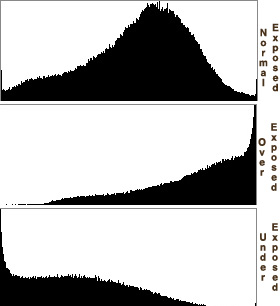
I mention that because it gives me an excuse to talk about my favorite feature on digital cameras: the histogram. The histogram is essentially a bar graph that tells you how many pixels fall into each tonal value, from dark to light. In a dark scene, the bars will be very high on the left; in a bright scene, they will be higher toward the right. Or ... if you're about to overexpose your shot, the histogram will skew to the right, and if you're about to underexpose, it will skew to the left. Here's what it looks like:

(Image from thedigitalstory.com)

Once you get used to it, this is as easy to read as the old in-camera meter, and far more informative. My old SLRs -- a Canon AE-1 and its replacement, a used Ftb -- could only give me a needle that told me when I was about to achieve a normal exposure. You had to be careful or it would make your shadows too bright, or your snow too dark, as "normal" was defined to be about as bright as grass and you had to always ask yourself: If I set the camera for normal exposure, will there be any detail in the shadows? Will that bright portion of the scene be blasted into pure white? Will the most important colors fade out through overexposure? That was part of the skill of manual photography - you had to make your best guess, based on experience and judgment. And maybe shoot three frames at different exposures, just in case.

The histogram gives you those answers. You can tell if your highlights are off the right edge, or whether the shadows are going to be all black. You can tell if, as in the photo above, the entire tonal range of the photo falls between black and white. In fact, I would have adjusted the exposure to lighten the whites even more in this photo, except that I was already at a slow shutter speed for a handheld shot at moderately high zoom and didn't want a blurry image.

I love that control. Right there on the screen, while composing the shot! I think Ansel Adams somewhere is jealous of me that I have a histogram and he never did.

Friday, February 11, 2011

Friday photo

Bison in meadow. Yellowstone National Park, December 2003

It's been a cold winter in Michigan this year, with heavy snowfalls to boot. Here in the southeast corner, we didn't get hit as hard with the last storm as, say, Chicago, because the heaviest snow passed to the north of us. But the last several evening have seen temperatures drop below zero Fahrenheit and bundling up is a useful skill.

I still benefit from my winters in Yellowstone. On cold days like we've had lately, I add a layer of thermal pants and shirt, two layers of socks, and a heavy sweater. With that, I only need add the windproof jacket and I'm plenty comfortable at the bus stop. It means I'm a little overdressed for indoor work, but I've always found that easier than being too cold. And I get the smug pleasure of enjoying weather that even hardened Michiganders gripe about. I still own a heavy coat that I bought for my first winter at Old Faithful, and which I wore perhaps two dozen times in while I was there and not once since leaving the Park.

The photo above? Taken at sunrise while temperatures were still fifteen or ten below zero. The sun isn't quite high enough to illuminate that layer of low-hanging fog, which seems to divide the world into a dark side and bright side.

Saturday, February 5, 2011

Some good photoshopping

"Impossible Celebrity Couples" at Buzzfeed, including this all-too-plausible scene of JFK with Anna Nicole Smith:


And twenty more. The Photoshop work throughout is just topnotch: the focus, grain, and contrast are matched perfectly.


Via The Daily Dish

Friday, January 28, 2011

Friday photo

Burton Memorial Tower, University of Michigan. Ann Arbor, Michigan, January 2011

Marion Leroy Burton served as the University of Michigan president from 1920-1925, and he had a dream. He wanted a bell tower. The University Library had contained a clock tower with chimes, which rang at 8:00 am and 6:00 pm to mark the beginning and ending of study time - kind of a cross between the bells of a monastery and a factory whistle - but the library was torn down in 1917* and now there were no bells. Burton wanted bells. In a tower.

He thought he had a good plan to sell the idea: it would be a memorial to the UM alumni who had perished in the Great War. But somehow, he couldn't drum up enough interest and the idea languished. And then ... Burton died. He had been only fifty years old and folks wanted to do something in his memory.

So Burton got his tower. With bells, an entire carillon, in fact. And it was a memorial, as he had proposed. I don't suppose he intended himself as the honoree, but that's why they call it irony.

It also shows what it takes to earn a building at UM. Meeting your demise during the greatest war the world had ever known is not sufficient. Were you to cure cancer, invent a cheap and abundant source of energy, bring peace to the Middle East, end world hunger, or discover an alien civilization, it wouldn't be enough to get a building named for you. You have to have been president of the University. Or else pay for it yourself.

As a side note, this also happens to be the first Friday photo from my new camera, a Canon SX30IS. It has a ridiculous 35x zoom capability, but I'm really more excited about its wide angle capacity. My previous digital cameras have had very little in that department and near-far composition has almost disappeared from my repertoire.


_________________________________________
* And replaced with a new one, no worries

Friday, January 7, 2011

Friday photo

Winter scene. Upper Geyser Basin, Yellowstone National Park, February 2005

Our scenery in SE Michigan isn't quite so wintry as this, but we've had snow on the ground since before Christmas and the sky is full of big fluffy flakes even as I type. Just as it should it be.

Tuesday, January 4, 2011

Worth the trip

Phil Plait at Bad Astronomy likes to feature the photography of Thierry Legault, and why not? He's just an amazing astrophotographer. Legault is especially fond of photographing transits of the International Space Station across the face of the sun and he made a special trip to Oman to catch one of these events during the latest solar eclipse:

Friday, December 17, 2010

Friday photo

Snow on pines near Midway Geyser Basin. Yellowstone National Park, January 2004.

Whee! Winter has arrived in southeast Michigan, snowy and cold as God intended it. Now if we can only get still more snow, and maybe have steam rising out of the ground to coat the trees with ice, it would look as wintry as Yellowstone.

Friday, December 10, 2010

Friday photo

Doublet Pool. Yellowstone National Park, November 2004.

Doublet Pool is one of the most attractive thermal features in the Upper Geyser Basin, if you find it - it's tucked away on Geyser Hill, across the Firehole River from the lodges, stores, and benches for viewing Old Faithful. I don't mean that it's really hidden away, but just that the folks who don't bother walking through the basin won't get to see it.

Doublet has been known to erupt slightly with a bit of bubbling, and on rare occasion even throw some water a couple feet in the air. Usually, though, it's just another of the steaming hot pools, with that clear blue (bacteria-free) water that the hottest pools have, and the red bacteria mats in the shallow areas where the water is merely warm and can sustain thermophilic life. It's called Doublet because there are two small pools connected by the narrow channel that you see in the photograph.

I don't entirely understand how the scalloped edges form. Silica is precipitating out of the water, slowly building up the mass on the sides of the pool. But why the round scallops? There's no sign of water draining into the pool and cutting channels; those would look like gullies instead of scallops, anyway. My best guess is that the edges begin jagged and random, but as the silica accumulates, it does so at equal distances around any pointed surface (recall that a circle is defined as the set of points equidistant from a given point). The tendency would be to grow the rounded scallops out from the edges of the wall and ever farther into the pool; pointy edges can't help being a passing phase. Or maybe there's some entirely different reason for that shape.

Friday, November 19, 2010

Friday photo

Old Faithful Inn Anniversary. Yellowstone National Park, May 2004.

In 2004, Yellowstone celebrated the 100th anniversary of the Old Faithful Inn, an originally quaint, now Byzantine wooden hotel that sits exactly one eighth of a mile from Old Faithful Geyser. Begun in the summer of 1903, construction was finished in time for the Inn to open the following season and it has been one of the most famous buildings in the West ever since.

That precise distance from Old Faithful Geyser is no accident. It was as close to the geyser as they could legally build. However, one notable, if often overlooked, feature of the Inn is that it is aligned to direct visitors' attention away from the geyser and toward the rest of the geyser basin. If you stand outside the front door, or lounge on the observation deck above the porte-cochere, you have to make a 90 degree turn to the right in order to look at the geyser. Looking straight out presents you instead with an invitation to discover the rest of the amazing Upper Geyser Basin, full of wonders such as Castle Geyser, Grand Geyser, Morning Glory Pool, and -- not the best, but my favorite name -- Spasmodic Geyser. If you come to the Inn and don't discover there's more to Old Faithful than Old Faithful Geyser, it's your own danged fault.

Unfortunately, the two huge wings added to either side in 1913 and 1928 spoiled the balanced appearance that the Inn originally presented (as well as blocking the view of Old Faithful from the dining room). Besides sprawling like overturned tractor-trailers off both ends of the "Old House," they abandoned the log construction of the original, as well as the A-frame roofs.*

However, the interior is still a delight. What I like in this photo is the number of distinctive Inn features I was able to gather into a single image. The distinctive wooden supports, both in full view on the opposite side, and close up so as to show the beetle scorings that create the most incredibly artistic-yet-natural effect; the US flag hanging over the lobby; the old electric lights; and, for the anniversary season, the large banner suspended from the ceiling and one of the smaller banners hung from the balcony. I rather regret the speaker in the lower right corner, as well as the light coming in from the dining room, but otherwise I enjoy the harmonious composition. This is one of those photographs where I spent a good twenty minutes fussing because the tripod was six inches too far to the left, or had raised the camera four inches too high.

The immense open space in the Inn lobby has been known to scare the hell out of modern structural engineers who venture into the building. The supports in the upper reaches look, shall we say, spindly, and they all seem to run mainly lengthwise, implying that the seven-story roof has no cross support. Apparently, that support exists elsewhere and the building is safer than it looks, and considering that it has stood for over a hundred years in a seismically-active region, and, survived the 7.4 Hebgen Earthquake, it would have to be.** Nonetheless, the recent renovation project has addressed some of the structural concerns, as well as making many aesthetic alterations. I left Yellowstone just as they were beginning and haven't been back in the meantime, but you can learn about them here.


Further reading:
Quinn, Ruth. Weaver of Dreams: The Life and Architecture of Robert C. Reamer.
Reinhart, Karen Wildung, and Jeff Henry. Old Faithful Inn: Crown Jewel of National Park Lodges.


_________________________________
* The flatter roofs are much friendlier to the winterkeeper who has to go up remove the snow that the high-pitch roof is supposed to shed, but doesn't always. In the film version of The Shining, we're told that a winterkeeper has nothing to do but putter around and keep the heat running; the truth is, there can be some hard work involved.

**I have heard it claimed, albeit not directly from an expert, that this was mainly because of the luck that the ground wave was traveling from northwest to southeast; had it come from another direction, the Inn would probably have collapsed.