Showing posts with label history. Show all posts

Friday, October 21, 2011

Friday photo

Au Sable River, Huron National Forest, Michigan. October 2011.

Here's another photo from my Au Sable trip. I thought I should offer up a nice colorful-trees image, while we're still in autumn.

The raft is a replica wanigan, a floating kitchen and supply store for lumbermen who worked in the deep woods, far from the main camp. Up the hill from this spot is the Lumberman's Monument, a celebration of those 19th Century men who supplied the nation with timber and stripped the Michigan landscape of its native cover. As you can see from this older image, they were effective at their jobs. The statue today is surrounded by second-growth trees.

Friday, September 2, 2011

Friday photo

Washington Monument. Washington, DC, February 2007.

Today's image features our National Phallus, the venerable Washington Monument. Begun in 1848, but not completed until 1884.1 It's the usual project, overly ambitious and poorly-administered, soon running over budget and sitting half-completed for a generation before someone decided to just finish the damned thing. Which they finally did, after they gave up the plan for the Greek temple surround the base. And it wasn't even a government project.2

The Monument has been in the news lately, of course, because of cracks discovered after the recent East Coast earthquake; more have been discovered in the wake of Hurricane Irene. Reportedly, the Monument is sound and not about to fall over, but that hasn't stopped our modern-day Jeremiahs from discerning God's wrath in natural phenomena. Pat Robertson begins with "I don’t want to get weird on this, but," and realizing it's already too late for that, continues, "it seems to me the Washington Monument is a symbol of America’s power. It has been the symbol of our great nation. We look at the monument and we say this is one nation under God. Now there’s a crack in it. Is that a sign from the Lord?” Not to be outdone, a certain Professor of Practical Theology3 at Southeastern University speculates on what message God might be sending, asking, "If the crack in the monument is, in fact, a God-sent ‘sign’ for the moment, then what might God be saying? And to whom is He speaking?"

I sometimes think God is just some great, vaporous infant. He cries every time He's unhappy, which is most of the time, but He can't tell you exactly what the problem is.

Perhaps He's just gotten around to noticing that the founder of His Own Country was honored by constructing a pagan edifice. The Washington Monument is an obelisk, a style of monument that first adorned Egyptian temples and has no Christian connotations whatsoever -- although the things are so cool that even the Vatican still keeps one that was erected by the beloved Emperor Caligula.

We needn't be surprised at this. Who can't admire the architecture of the Classical Age? If you look around Washington, DC, you'll see a lot more references to classical Rome and Greece than you do to Christian sources, and the buildings all resemble Greek temples more than Christian cathedrals. Both Rome and Greece also copied the Egyptians' obelisks. The Romans not only built their own, but they plundered them from Egypt, too, long before Napoleon began the modern tradition of collection development, so that today only half of all surviving Egyptian obelisks are still found in Egypt.

Frankly, I don't mind a bit that, in honoring our primary Founding Father, Americans also honored one of the most accomplished cultures of the ancient world.


______________________________________________________________
1. Which makes me think of Orwell's 1984, which was published in 1948 and gained its title by reversing that last two digits. But I can't quite make any other connections, so I guess I'll have to drop the whole thing.

2. If you look closely at the photo, even though it's backlit, you can see the difference in color between the marble in the original base and that used to complete the monument.

3. It's hard to even type that without giggling, isn't it?

Saturday, August 27, 2011

Book review: AD 381

A couple years ago I wrote a post about Charles Freeman's book The Closing of the Western Mind, which argues, in a nutshell, that the triumph of Christianity in late Antiquity truly did usher in an intellectual Dark Age, wherein philosophical and scientific questions (and there was not yet a distinction between the two) were settled by theological arguments from authority and free inquiry was discouraged. In A.D. 381, Freeman continues his argument, exploring in more detail how the late Roman emperors injected themselves and the state into theological disputes.

Several reviewer of the book have complained that Freeman in simply updating Edward Gibbon and blaming Christianity for the fall of Rome. This is not how I read Freeman. He blames Christianity – or, to be more precise, certain later Christians and Roman emperors, and the precedent they established – for killing off a great and ancient Greek tradition of free inquiry. But he does not blame Christianity for bringing down the Empire itself.

By the end of the 4th century, while Christianity was growing but did not yet dominate, the Empire was barely maintaining itself. Grown too large for its own governance, it had split into two coeval sections, with capitals at both Rome and Constantinople governing the West and East. The powerful Persian Empire threatened the East, numerous Germanic tribes were invading from the North, and Roman armies were spread across borders that had grown too long and too distant to be efficiently defended. With the military removed so far from the core of the empire, the interior trade routes were less well-guarded and commerce became more difficult and expensive.

Although the East retained a cohesive state for another thousand years, the West disintegrated both politically and economically. After 400, trade all but disappeared in Western Europe. Cities became small towns; the money economy disappeared; well-manufactured goods, once common in even a peasant household, disappear from the archaeological record. Rome's famous aqueducts went dry for a millennium, and even the lead and copper pollution levels recorded in ice cores testify today to the demise of manufacturing during the Medieval Period.

***

None of this does Freeman blame on Christianity. Given the entirely worldly difficulties that Rome faced, it should be no surprise if the Empire failed to overcome them all. As I read Freeman, he would instead blame the fall of Rome for the intellectually authoritarian turn that Christianity took following the 4th Century. Throughout the Roman world, the scholarly decline was almost comparable to the economic and political collapse. According to Freeman's account, even the renowned Medieval scholars are recognized to have written poorly and less grammatically than their predecessors; where a rich Roman citizen could possess a library with thousands of works, medieval monasteries would be considered impressive if they contained a few hundred. Theology replaced naturalistic inquiry. A Christian mob probably destroyed the remnants of the Great Library at Alexandria1 in 391, and in AD 529, Plato's Academy was shut down after 900 years of free inquiry. Had the Christian authorities not been so hostile to non-Christian literature, more would likely have survived to the present day.

What happened? By Freeman's reckoning, the emperors meddled in theology and set a precedent of resolving scholarly disputes through authority instead of inquiry. As the Empire's organization became ever less adequate to meet external threats, the later emperors were prone to blaming their ineffectiveness on a lack of internal unity. And as Christianity absorbed more and more of the Empire's inhabitants, the emperors began to see the divisiveness of the Church as a principle weakness of the empire. In the centuries after Jesus's death, Christian clergy had taken the Greek practice of philosophical disputation, applied it to theology, and then – disastrously – made it a matter of eternal life or death to declare and defend a single position. “I don't know” was not an acceptable answer, even though it would have been the best answer to questions which were essentially unknowable.

One of the major, unknowable, questions concerned the exact nature of Christ – was he fully human, or fully divine? Maybe he was a human who was temporarily occupied by God? Or was he entirely God all along and only appeared human? However you answer the question, some unpleasant consequences seem to follow. If he was human, then why should we be worshiping him? Or if he wasn't human, then he could hardly have suffered through his crucifixion, in which case his great sacrifice would seem to be greatly overtouted. According to the disputants, immortal souls were at stake, although a cynic might notice that the emperors' habit of extending patronage to certain churches meant there was a lot of money and status at stake in elevating one's own views and disparaging a rival's.

The emperors began to take sides in these disputes, something that had never happened with philosophy or pagan religion. In AD 381, the emperor Theodosius issued an edict declaring the Nicene faith – an incoherent declaration that Jesus was simultaneously fully God and fully human, and you could conveniently flip from one to another whenever you needed to dodge a contradiction2 – was orthodox and that all other views were heretical. Clergy with contrary views were disfranchised and their churches closed. A decade later, Theodosius banned pagan rituals and sacrifices altogether.

Theodosius's efforts did not succeed in solving theological questions; all he managed to do was thoroughly politicize these disputes and cement the role of the state in establishing religious orthodoxy. Through the following century, Christians continued to gain strength and began to suppress pagan practices even more thoroughly than had been Christianity in earlier eras.3 Curiously, the disputatious eastern empire survived as the Byzantine Empire until 1453; it was the western empire, where theological questions seemed less urgent and there was no such thing yet as “papal authority,” that thoroughly fell apart.

As for the promises of orthodoxy … Freeman tells this story. In AD 428 the bishop of Constantinople, Nestorius, put the case as baldly and boldly as could be: “Give me, king, the earth purged of heretics, and I will give you heaven in return. Aid me in destroying heretics and I will assist you in vanquishing the Persians.” A few years later, Nestorius himelf was condemned for portraying Jesus as too human. Not that he had adopted any known heresy; he just wasn't orthodox enough. Thus the promise of fundamentalism; thus the all-too-often-delivered reality.

________________________________
1. The case is ambiguous and disputed. It seems likely that the Library suffered several episodes of destruction after its zenith in the last couple centuries BC. It's not clear how much was left to be destroyed by the mob in 391, but they did destroy what they found.

2. Yes, that's my own definition.

3. It comes as a surprise today to be told that the Romans were religiously tolerant, but it's fairly true to say they were. In conquered territories, they did their best to amalgamate local religion with their own, while polytheism would naturally tolerate anyone's decision to choose a certain god as his particular patron. An upstanding citizen would be expected to make a show of honoring a city's gods, just to keep them happy, but this didn't require him to reject any other gods. Jews refused to adopt polytheism, but they were never upstanding citizens (generally not legal citizens at all). I'm not well-studied enough to say this with confidence, but I suspect Christians would never have suffered persecution if the religion had remained confined to the lower classes; their religious views wouldn't have mattered to anyone.

Friday, August 26, 2011

Friday photo

Golden Spike National Historic Site, Promontory, Utah. June 2005.

Did you know it could have been "Golden Rail National Historic Site"? Alas, a certain San Francisco booster discovered there wasn't enough enthusiasm for donating that much gold, so he settled for a golden spike instead. Nevada also offered a silver spike (from the Silver State, of course), while Arizona produced a silver spike with a golden head and a San Francisco newspaper gave a second golden spike. At the famous completion ceremony, these were (gently) tapped into place with a special silver-plated maul and then immediately pulled out again so that real spikes could be put in their place. Railroad magnates Leland Stanford and Thomas Durant tried to drive the iron Last Spike into place, but made a hash of the job; a real rail worker had to finish. The precious spikes were dispersed to various repositories and none resides at Promontory today*.

As a matter of fact, neither does the transcontinental railroad. The site was forced as a huge and inconvenient detour around the Great Salt Lake and, even today, it's almost 150 miles of vacant desert and single-lane road from Brigham City. Fortunately, the Salt Lake is quite shallow and crossing it with a trestle was well within 19th Century engineering capabilities. The Southern Pacific Railroad** completed such a cutoff in 1904 and, except for tourists visiting the National Historic Site, no one has seen much need to travel around the north side of the lake ever since.


A previous post on the financing of the transcontinental railroad


___________________________________________
* The second golden spike has since been lost, perhaps in the 1906 San Francisco earthquake and fire

**Not part of the original transcontinental railroad, which was built by the Union Pacific and Central Pacific railroads.


Friday, July 15, 2011

Friday photo

George Gordon Meade Memorial. Washington, D.C., March 2007

Friday photo, public softcore edition. George Meade, of course, was a Union general of the Civil War who took command of the Army of the Potomac and, in his first battle, decisively defeated Robert E. Lee at Gettysburg, crippling the Confederate army and and earning a statue of a naked woman ministering to him. If he was awarded the real thing, it has gone discretely unrecorded

According to the description on Wikipedia, that's Chivalry to Meade's left, accepting the offer of a coat she obviously needs a hell of a lot more than he does. The dude copping a feel from behind her is Progress; it's not clear whether he's progressing upwards or downwards.

It might only be my inner sixth-grader that gets so amused by this statue, but it also amuses me to see how dramatically cultural tastes and norms change from generation to generation. The 1860's were a pretty religious and typically prudish age, but even the genteel classes saw no embarrassment in adding a naked figure to a statue of a hero and putting it up in the nation's capital, for all to see. I'm guessing this is because they still admired the art and literature of Classical Greece and Rome, whose statuary features plenty of nude figures. I'm not an art historian, but I would hazard a guess that any nude in a 19th Century statue almost certainly represented one of the ancient gods or was the personification of some abstract virtue. Nudity in the 19th Century was not about sensuality; it demonstrated your good taste and your classical education.

Friday, July 1, 2011

Friday photo

Rainbow over Hayden Valley. Yellowstone National Park, June 1995.

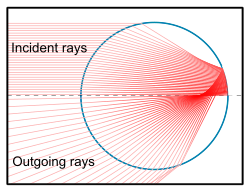
Rainbows. The only cheaper subject for a nature photographer is sunsets, and that only because they happen to you more frequently. You get especially spoiled living in the mountains, because unlike the Midwest, where the clouds may cover the entire sky for hours on end, a sharp end to the storm is likely to arrive while the rain is still falling. Also, thunderstorms are especially common in late afternoon and when the cloud's edge approaches, the sun is sinking down to the optimal level for creating rainbows (a 42° angle from sun to rainbow to observer).

As far as the mythology of rainbows goes, I'm mostly familiar with the Noah story, where God promises never again to destroy the Earth with a technique that could never have worked in the first place. You can read a quick summary of some alternative mythologies at the relevant Wikipedia article. I often wonder how much anyone took these stories seriously; after all, we all still know the myth of leprechaun's gold at the end of the rainbow, although people who believe it are probably as scarce today leprechauns. Were these stories ever for the adults, or were they always meant as children's entertainment?

Still, I was a bit surprised to learn how long ago people were trying to figure out how rainbows work, from a naturalistic framework. Based only on surviving writings, we can push it back at least as far as Aristotle in the 4th century BCE. It was probably easy enough to understand that the sunlight was being reflected back from water droplets in the air, since the rainbow always appears in the opposite direction from the sun and, in fact, you don't even need rain. The spray from a waterfall will do nicely. But the Greeks were also damned good with geometry, and Aristotle used these skills to explain how logical it was that that the rainbow should have such a perfect semicircular shape. He grasped that the light had to be reflected at a particular angle back to the observer and that the entire set of points that satisfy this condition would form a circle.*

Figuring out why their are colors is pretty tricky, but sometime around 1300 the Persian astronomer Kamāl al-Dīn al-Fārisī used a large, spherical globe filled with water to model a raindrop and worked out that the ray of light is refracted twice, once as it enters the droplet and again as it leaves, having bounced off the far interior wall. He eventually concluded that the white light was somehow being decomposed into the various colors, anticipating Isaac Newton's famous prism experiments in the 1680's


Traditionally, we divide a rainbow into seven colors, but those bands don't really exist and Roy G. Biv is as fictional as Cupid. The bending of the light is seamless and the change in colors ought to appear perfectly seamless as well. But we don't see color that way. We have three types of photoreceptor cone cells in our eyes that each respond to a different wavelength and what we see is a calculation based on those three inputs. Birds, reptiles, and amphibians, on the other hand, have four or five different types of cones and almost certainly can discriminate colors far better than we can. Set your monitor to 256 colors and take off your glasses - that's probably how a bird would feel if you were to suddenly give them human vision.


_________________________________________________
* The ground cuts off the bottom half of the circle, of course, but full circle rainbows can be seen from the air. I have a cousin who flew on helicopter gunships in Vietnam and tells me that he saw one. I could really envy him the experience, if it weren't for all that war and shooting and danger business that went along with it.

Wednesday, June 8, 2011

Knowin' my history ....

In the wake of Sarah Palin's defiant defense of her description of Paul Revere's ride, a lawyerly defense that she certainly must have needed explained to her after her sycophants dreamed it up for her, I'm trying to imagine her book report on George Washington. I picture it going something like this:

He who chopped down those cherry trees so that we could have homes and towns and, um, making sure while he's standing in that boat fathering our country that, uh, we're not going to lie about defending free enterprise and we're going to develop our country.


Makes as much sense as her comments on Revere, I'm afraid, except that the cherry tree story isn't at all factual. Doesn't matter; neither was Palin's portrayal of Paul Revere. Oh, sure, if you tear her paragraph limb from limb, you could overlay each part onto an accurate version of the event, but that's not historical knowledge. Poor students do this all the time and anyone who's taught history has seen it in exam booklets over and over: disconnected facts dropped almost randomly on the page, with no sensible connection between them, which read like a 2-year-old playing with a jigsaw puzzle. It's simply not possible for someone with any adequate understanding of the night of April 18, 1775, to have uttered that phrase.

Palin is that student who sat in the back of the class without listening, absorbing a few scraps of information without understanding any of it. She knows Revere rode a horse, she knows it was during the Revolution and that the British were the enemy, she's been told something about bells being rung in warning, and she even knows that it somehow connects to the famous "Shot Heard 'Round the World," although she doesn't know how. And she hurriedly assembles these random facts and comes up with a mental image that's completely wrong: Paul Revere riding through the streets of Boston ringing bells and firing warning shots.

As the saying goes, historians never miss a chance to miss a chance to educate the public on historical knowledge. It's depressing to see some historians, however reluctantly, declare that if her isolated factoids aren't entirely bogus, than her whole story has to be considered historically accurate. It does not, any more than a NAPA store is an automobile. That's why history exams include essay questions, where you can't make the lucky guess that might win on Jeapordy! You have to show you understand what your facts mean. By letting Palin's comments pass for "historically accurate," the whole concept of historical understanding gets short-changed.

Friday, June 3, 2011

Friday photo

Mammoth Hot Springs, Yellowstone National Park. May 2005

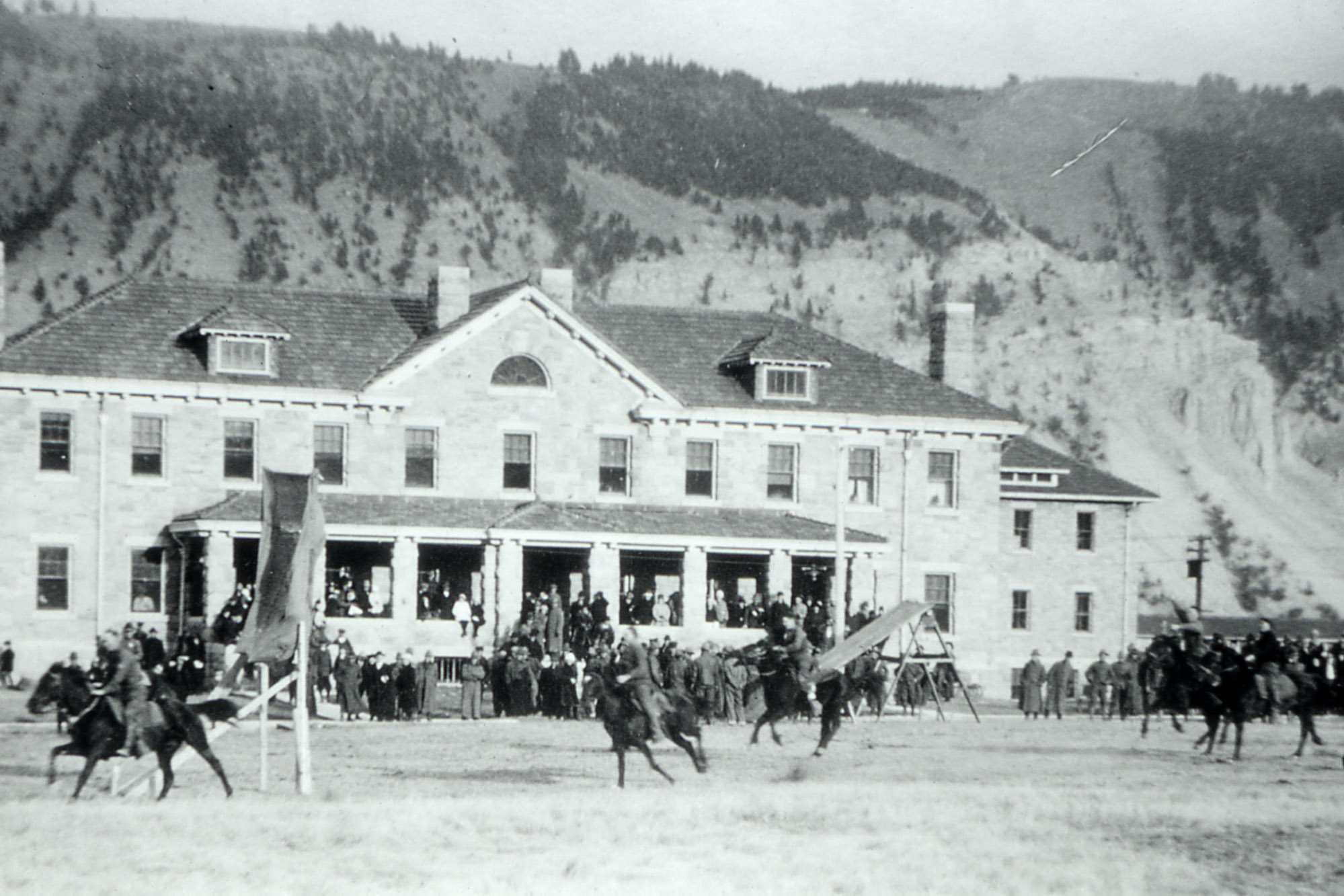
Here's a nice little view of Mammoth Hot Springs, the headquarters for Yellowstone National Park. It's just inside the northern boundary, 50 miles from Old Faithful and even farther from the more remote reaches of the park; it was selected more for its convenience to the outside world than to the rest of the park. The first government building1 in Yellowstone was a blockhouse built in 1879 on Capitol Hill (the slope you see extending out of the upper right of the frame in the photo); the superintendent was still worried about the possibility of Indian raids (the Nez Perce, fleeing the US Army, had come through just a couple years previously and had killed a couple of tourists).

The red-roofed buildings in the distance are stone officer's barracks from the Fort Yellowstone days, when Yellowstone was an army post between 1886 and 1918. The US Army had been given control over the park after understaffed civilian administration failed to prevent poaching and other destruction. By all accounts, the Army did a commendable job, policing the tourists effectively and reducing poaching to levels that the wildlife could survive.

Those officer's barracks are still in use, most of them serving as residences, while the one nearest the main road is now the Visitors Center. The cottonwood trees lining Officer's Row were planted with, shall we say, military precision: they form a perfectly straight line from one end to the other. That flat area between Capitol Hill and the yellow hotel and restaurant on the left was a parade ground for the cavalry troop stationed there -- even though it's prone to sinkholes. In the winter, the parade ground was sometimes flooded to form a skating rink.2

The Army gave up command in 1918, when the newly-minted National Park Service was up and running. They were ready to go, since it no longer made sense to station soldiers along the former frontier when they were badly needed elsewhere. But they left behind some solidly-constructed buildings and a helluva lot more wildlife than there would have been without them.


More reading:
Bartlett, Richard A. A Wilderness Besieged
Haines, Aubrey L. The Yellowstone Story

_____________________________________________
1. There was already a hotel at the site, to serve tourists who wanted to explore the hot spring terraces before heading off into the interior.

2. This is still done today, but behind the hotel and not on the parade ground.

Thursday, June 2, 2011

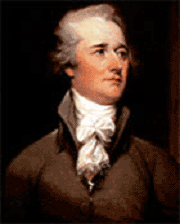
Alexander Hamilton, borrower and taxer

Dragooning the Founding Fathers to fight contemporary political battles is a time-honored tradition. Without a doubt, if Washington, Jefferson, and Adams were all here, they would ... well, they'd agree with me and take my side on every question. And since their word is Holy Writ, that proves I'm right. About everything,

Okay, not really, but I do sometimes find myself wondering what the FF's would think if they could suddenly be transported from their day to ours. I tend to imagine them stumbling around dazed for a few days, loading up on hard liquor, and then, when that runs out, quietly going off to kill themselves, James Madison perhaps muttering darkly “I told you it would never last.” Only Alexander Hamilton, I suspect, would recover from the dizzying shock and slowly come to think, “Hey! It worked! Commerce! Wealth! Power! Oh, it's everything I wanted!”

Hamilton, as the man most responsible for putting the United States on a sound, capitalist-friendly fiscal footing, has long been a favorite of conservatives. A historian whom I can't recall once noted that one can trace the relative ebb and flow of conservatism and liberalism by counting the rise and fall in biographies of Alexander Hamilton and Thomas Jefferson. It's no coincidence that one popular biography of Hamilton was penned by a senior editor of National Review.

So, while the question of the day is about our national debt, and whether or not the GOP is bluffing about be willing to default, if I could conjure up just one of those Founding Fathers, I would want to hear what Hamilton had to say. Because if there could be such a person as the patron saint of the national debt, Hamilton is the man. He believed in a national debt. More importantly, he believed in timely, reliable payment of that debt. That last point is crucial; in fact, Hamilton actually advocated having a national debt just so that the government would need to make timely, reliable payments. Long before there were any guitar-playing pirate-waiters to make the point, Hamilton preached the value of a solid credit rating.

Hamilton knew that, whether they like it or not, governments sometimes have to borrow money. Emergencies happen, mainly unexpected wars when the country would need to quickly raise, train, and equip a larger army than it could afford to maintain permanently.1 The kings of Europe had found themselves borrowing money from banks for centuries and the US would be no different. It couldn't be helped.

What could be helped, however, was the rate of interest that the government would need to pay when it did borrow. Governments needed a good credit rating at least as much as merchants did. Hamilton had closely watched how the British government operated and was deeply impressed. The British borrowed constantly, repaid promptly, and by proving itself the pinnacle of safety, could borrow at the lowest possible rates. Hamilton had come away deeply impressed with England's ability to leverage money and, as the first Treasurer of the United State, he wanted his new country to do the same.

To do so, however, was going to require a hard-core sales job. The Continental Congress had borrowed outrageous sums of money financing the War of Independence, still owed soldiers their back pay, and was hard-pressed figuring out how to pay off everyone they owed. Millions of dollars in loans were owed to private individuals, but many of those people were not the original lenders. Over the years, as the nation's poor financial standing became increasingly apparent, many people had sold their securities to speculators, at a substantial discount (often as low as 15% of face value). To many traditionalists in Congress, men who approached financial matters from a moral perspective, it stuck in the craw to simply pay the current owner full value. Hard-working, patriotic Farmer Brown, who had risked his scarce capital to aid the struggling Revolution when the outcome was uncertain, would never get more than his 15¢ on the dollar. The sharp speculator who bought the loan from him would succeed in making a killing off Mr. Brown's distress.

Hamilton did not say, “Morality be damned, we have bigger fish to fry,” but that is the gist of his 1790 Report on Public Credit. At all costs, the United States must demonstrate good faith in paying its debts. "Credit rating,” although the term hadn't been coined yet, but the concept is foundational to all of Hamilton's policies. The people with money should be willing to lend it to the government. No, they should be eager to lend money to the government. They should be so certain that their investment is rock-solidly safe that they will lend at the lowest possible rates. Anything else, any policies that shake the confidence of investors in the reliability of the Treasury, will end up increasing costs, squandering treasure, and draining investments. Everyone loses, both as individuals and as the Public.

But why was it necessary that the current holder get the full payment, and the original purchaser nothing beyond what he had sold the bond for? Hamilton made a feeble effort to defend the speculators on moral grounds, arguing that he too had risked his money on an uncertain outcome and demonstrated his faith in the nation. Given the way government officials were moving to profit off a scheme that looked less and less risky,2 it was an unconvincing argument. Hamilton may have advanced it only half-heartedly anyway, since it was beside the point. Again, he was looking to the future and the future he wanted was one where investors not only could loan with complete safety, but could sell their bonds at full value anytime they needed to. The bonds would be easily traded because the purchaser would know that he could redeem it at full value. With that kind of value, a government loan would be as good as money. It would be money, for all practical purposes, and those practical purposes were uppermost in Hamilton's mind.

Specie, that is, gold and silver coin – the original cold, hard cash – was scarce in North America and hard to increase without discovering more metal. A growing economy needs a more flexible money supply and rock solid government bonds would fit the bill nicely. If money is more plentiful, it can be borrowed more cheaply, to the benefit of everyone attempting a profit-making venture. Settlers could purchase homesteads; merchants could fill ships with goods. Again, everyone wins.

A solid, reliable national debt was an essential foundation to it all. It meant cheaper borrowing for the government, and ultimately lower taxes to pay for it. Entrepreneurs would have access to cheaper money, too, removing an impediment to trade and development. Hamilton was the great advocate of capitalist development, but it all depended on a government that was scrupulous about meeting its obligations.

No doubt Hamilton would have abhorred the way we spend tax money; I can't imagine him approving of Social Security or Medicare. But would he have been willing to gamble the nation's credit rating, even to eliminate the evils of social spending and high taxes?3 Perhaps, if he had to choose between modern levels of government spending or toying with default, he would tell Madison to move over and also drink himself to death.


_________________________________________________
1. If I had to list the number of ways in which the United States departs from its founding ideals, the modern military would be at the top of the list. A large standing army, it was believed, would almost inevitably be used to control the public; it would tempt Presidents to seek glory in foreign adventures; and if neither of those happened, it would still be an enormous financial burden. Of the three, only the first danger has failed to emerge. On the other hand, we've so militarized our police forces that it hardly makes a difference.

2. Several Congressmen, and at least one Treasury employee close to Hamilton (although apparently not Hamilton himself) were sending agents scouring the country for loans to buy up before word got out and the price began to rise. Such insider trading is, of course, illegal today.

3. High to him; current tax collection is, overall, a bit low compared to late 20th Century norms.

Wednesday, May 4, 2011

Who is Bin Laden?

Years ago I came across a pile of 'ancient' Reader's Digests and found an anecdote from 1944 or 1945, which told of British mother whose young son was puzzled when she referred to an object on the beach as a "shell." He knew nothing of seashells; the only shells he knew were the exploding kind.

That came to mind when I read this post by Jamelle Bouie at the American Prospect blog. The 5th-most-common Yahoo search on Osama Bin Laden this week is the basic question, "Who is Osama Bin Laden?" Mostly, this came from teenagers, the oldest of whom were only 7 or 8 when 9/11 occured. Observes Bouie,

Given the extent to which bin Laden had mostly drifted from our national conversation (especially in light of the Great Recession), it's not a huge surprise to learn that a non-trivial number of teenagers are baffled by his significance. Still, it's sobering; not because it reveals anything profound about our educational system or the attacks on 9/11, but because it points to an absolute truth: for each generation, America is a very different place, and the America we lost on 9/11 -- the America that didn't profile citizens, torture people, or monitor their phone calls -- isn't even a distance memory for the children and teenagers of today's America.

Friday, April 22, 2011

Friday photo

Tower Fall. Yellowstone National Park, May 2002.

It's peculiar that I had lived in Yellowstone for so many years before I ever caught Tower Fall at the right time of day for this scene: the massive spray from the waterfall backlit by strong sunlight, filling the entire canyon with a dazzling light. I have this scene in both slides and born-digital images and may have to scan one of the slides someday for comparison.

Tower Fall is a fine example of a hanging creek, a small river that's cutting downward as fast as it can, but just can't keep up with the more powerful and erosive river that it empties into. In this case, Tower Creek has to drop 132 feet in order to catch up with the mighty Yellowstone River just a couple hundred yards away. Multnomah Falls near Portland, Oregon, is an especially spectacular example, if you happen to be going that way.

The creek and waterfall were named by the members of the Washburn expedition of 1870 early in their explorations. In his account of the expedition, Nathanial Langford added this footnote to the story of the naming of Tower Fall:
At the outset of our journey we had agreed that we would not give to any object of interest which we might discover the name of any of our party nor of our friends. This rule was to be religiously observed. While in camp Sunday, August 28th, on the bank of this creek, it was suggested that we select a name for the creek and fall. Walter Trumbull suggested "Minaret Creek" and "Minaret Fall." Mr. Hauser suggested "Tower Creek" and "Tower Fall." After some discussion a vote was taken, and by a small majority the name "Minaret" was decided upon. During the following evening Mr. Hauser stated with great seriousness that we had violated our agreement made relative to naming objects for our friends. He said that the well known Southern family -- the Rhetts -- lived in St. Louis, and that they had a most charming and accomplished daughter named "Minnie." He said that this daughter was a sweetheart of Mr. Trumbull. Mr. Trumbull indignantly denied the truth of Hauser's statement, and Hauser as determinedly insisted that it was the truth, and the vote was therefore reconsidered, and by a substantial majority it was decided to substitute "Tower" for "Minaret." Later, and when it was too late to recall or reverse the action of our party, it was surmised that Hauser himself had a sweetheart in St. Louis, a Miss Tower. Some of our party, Walter Trumbull especially, always insisted that such was the case. The weight of testimony was so evenly balanced that I shall hesitate long before I believe either side of this part of the story.

Given Nathanial Langford's track record with campfire stories, I wouldn't hesitate an instant before disbelieving every side of this part of the story. His tale of the origin of the national park idea, that the party was camped at the confluence of the Firehole and Gibbon Rivers (to form the Madison) discussing the profits to be made from claiming the areas around the waterfalls and geysers under the Homestead Acts and charging tourists to see them, when one of his companions solemnly declared that they should reject such base scheming and work to have the area given over to the people as a national park -- well, that story has long been debunked, with a corresponding decline in Langford's reputation as a scrupulous man.

In any event, Walter Trumbull ended up marrying a woman named Slater, while Samuel Hauser married one Helen Farrar only a year after this supposed campfire spat. You'd have thought naming a waterfall in the first national park after your lover would earn you a few more boyfriend points than that, but women are fickle, I suppose. Neither man ever managed to marry a Miss Tower or Miss Rhett.


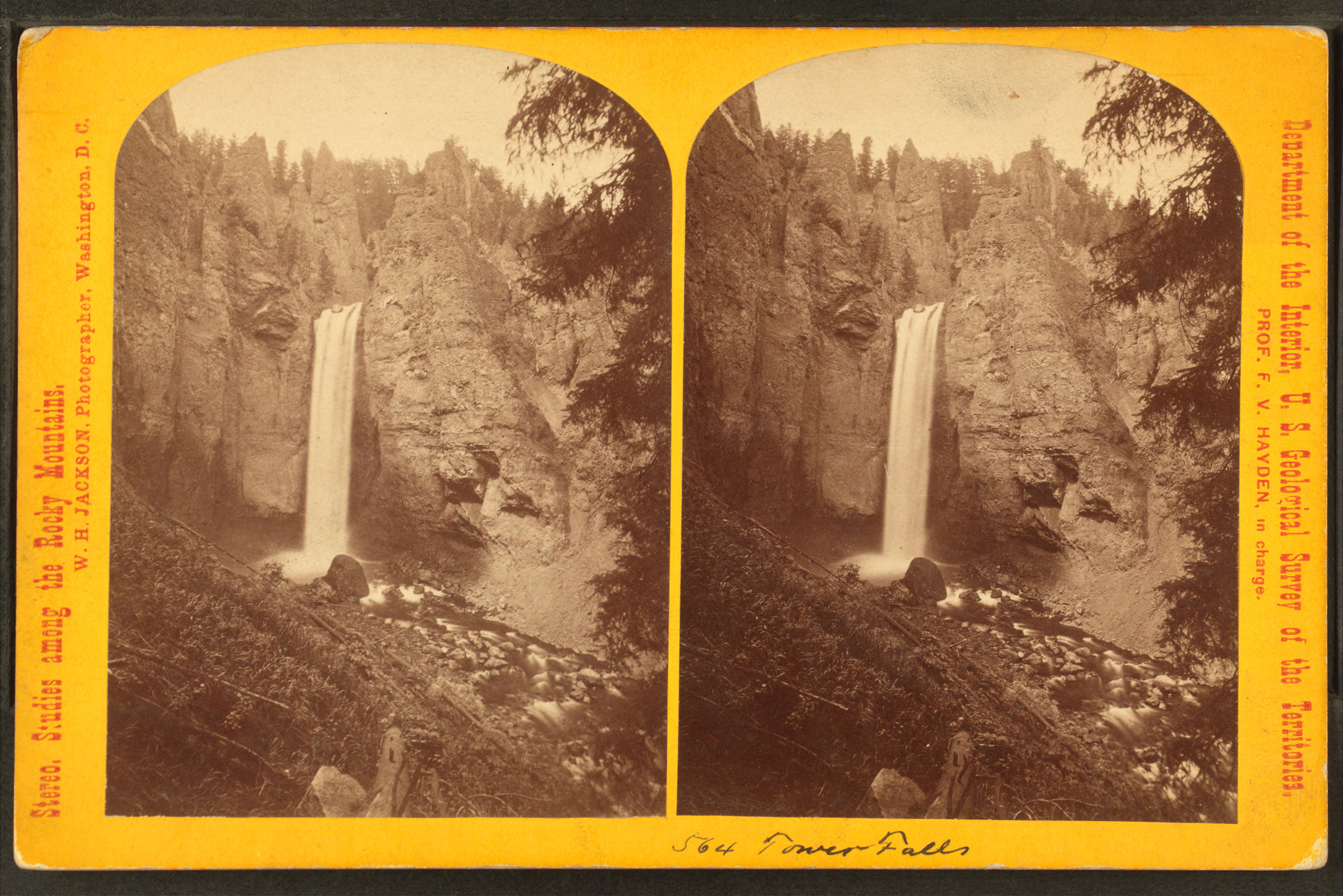
This William Henry Jackson photo nicely illustrates why "Minaret" would have been an entirely appropriate name for this waterfall. The sketch below was made by one of the soldiers on the Washburn expedition and, as far as us white folks go, is certainly the very earliest pictorial representation of Tower Fall.

By the way, if you click on the Jackson photo and look closely, you'll spot a small boulder perched precariously on the edge of the waterfall. For over a hundred years, tourists enjoyed speculating on how long it could stay there; it looked like it should fall any minute, but maybe it would last another century, or two, or three? Well, it didn't. Spring floods knocked it off the edge in 1985 or 1986, shortly before I first laid eyes on Tower myself. Alas.

Thursday, March 10, 2011

Found in the archives


A volunteer at the Smithsonian Institute has discovered color photographs of San Francisco after the 1906 earthquake.

Although hand-colored photographs of the quake's destruction have surfaced before, [Eugene] Ives' work is probably the only true color documentary evidence, Shannon Perich, associate curator of the Smithsonian's photography history collection, told the Chronicle.


Update: the volunteer himself blogs the discovery

Wednesday, February 23, 2011

TJ's library

In the news today: the discovery that Washington University in St. Louis has (previously unbeknownst to them) been harboring some six dozen books from Thomas Jefferson's private library.

It took a little detective work: knowing that Jefferson's granddaughter's husband had purchased some of his books at auction; learning that the family of said grandson had donated their books to Washington University in 1880; finding an early-20th Century library ledger that helped to identify the donated books; and then discovering Jefferson's initials in the suspect books. It's no wonder that even the library didn't know the noteworthy provenance of their possessions.

Jefferson initialed his books in a peculiar way. When books are bound, groups of pages known as signatures are stitched together; the signatures need to be marked so that they get assembled in the correct order, and were often marked with letters of the alphabet. So where Jefferson found "I," he added a "T" in front of it; after the "T," he added an "I." Why "I"? Doh! You saw Indiana Jones and the Last Crusade! You know that "I" is used in Latin for "J," and why it's a matter of life or death to know that!

This reminds me of a memo I read a few months ago in the Special Collections here at UM. The very first purchase of books for the Library were made in 1838 by Asa Gray, who had been hired by the University of Michigan before some sort of funding mixup led him to take a position at Harvard instead. Around 1970 or so, the Library got a little history-conscious and began trying to track down those books that had been part of his original purchase. Some of the departments that held the books didn't want to give them up and I recall a pleading memo to the effect of, "If you can't take this rare and singular book off your shelves, could you at least put it on reserve and stop letting the students take it home?" I expect Jefferson's books were no longer in open stacks, but had probably experienced similar use in their day.

By the way, how cool is it that some of Jefferson's books would have accidentally ended up in St. Louis, of all places, the Gateway to the West that he had purchased? Seems utterly fitting.

Saturday, January 15, 2011

Greatest prank ever

I should have posted this one for the Rose Bowl game two weeks ago, but better late than never. Here is the greatest prank in the entire history of the planet, or at least that portion of history that's come to my attention, which surely must amount to nearly the same thing. You almost wish the word pwned had existed then.

Anyway, read about the great Rose Bowl prank of 1961, when fourteen Cal Tech students stole the plans to the University of Washington's proud flip card routine, and offered a few improvements of their own.

Tuesday, December 14, 2010

The Peculiar Institution - the South

Here's an interesting article in the NYT about a map showing slave populations in the South, compiled from the 1860 Census data - the high water mark for American slavery. And the last time a Census could even compile information on that particular demographic. Historian Susan Schulten notes,

The map uses what was then a new technique in statistical cartography: Each county not only displays its slave population numerically, but is shaded (the darker the shading, the higher the number of slaves) to visualize the concentration of slavery across the region. The counties along the Mississippi River and in coastal South Carolina are almost black, while Kentucky and the Appalachians are nearly white.

Translating numerical data into visual representations is one of the most powerful communication techniques available. The patterns just pop out at you. No wonder people were so taken with this map.

The presence of slavery, and (after 1865) large populations of African-Americans, wasn't the only thing peculiar about the South, though. There was a remarkable absence of foreign-born whites as well. Recently I was poring through the Statistical Atlas from the 12th Census of the United States -- that's from 1900, just to save you the arithmetic -- and came across this fascinating chart.


Click on the "Go to source" button to see it. The chart shows a breakdown of each state's population by race and origin. Four races are listed: Indians, Chinese & Japanese, Negro, and White (corresponding to the "Red and yellow, black and white" that I learned singing "Jesus Loves the Little Children" 'way back in Sunday School*). For whites, there are three further subdivisions: native white of native parents (baby blue), native white of foreign parents (pink), and foreign-born white (green). These were the categories that mattered in 1900.

Notice the states with the longest black lines - those are the Old South, the slave-holding South before the end of the Civil War, and the states that still held the majority of the nation's black population before the Great Migration. And in 1900, a period of intense immigration, most of those states had little to negligible pink and green in their bars. In other words, almost everyone who wasn't black was a white of at least the second generation. In a nation of immigrants, the South drew almost no immigrants.

According to the next couple of Censuses, little changed during the next 20 years. Bear in mind that this is one of the most immigration-heavy periods in US history. Yet the South missed it. They first developed enough of a separate identity to secede from the rest of the country, then learned to resent outsiders all the more intensely -- as you would, too, if you'd suffered invasion, defeat, and military occupation for a dozen years. And then they had the privilege, if privilege it is, of remaining insular while the rest of the country went through the wrenching experience of assimilating people who were as foreign as could be imagined (not only Chinese and Japanese, but Irish, Italians, Greeks, and so forth).

In respect to immigration and Americanism, it was even uglier 100 years ago than it is today. The "hyphenated American" (e.g., German-American) was no American at all, said Theodore Roosevelt, while Woodrow Wilson compared the hyphen to "a dagger that [the immigrant] is ready to plunge into the vitals of this Republic." The 1924 National Origins Act represented an unabashed attempt to keep the US not just white, but lily-white, by limiting the number of immigrants from unpopular nations.

The South didn't need the help, though. Aside from a few Yankee carpetbaggers, unwanted immigration wasn't part of their experience. Other people's families had been there just as long as yours and their brand of religion was probably the same as yours. No one had to accommodate diversity, when there were only two ethnic groups and their status was legally defined.

If it seems at times that Southern culture is especially prone to creating parochial mindsets, and people who steadfastly refuse to accept that not everyone thinks the same as they do -- and that is how Southern culture often comes across to me, at least as expressed in politics and the culture wars -- then maybe this is part of the reason why: no other region in the country was allowed to remain so culturally insular for so long a time.


______________________________________
* Which dates from about the same era, interestingly enough. This piano rendition renders the tune in fine 19th Century style.

Friday, October 29, 2010

Friday photo

Colter Bay, Jackson Lake. Grand Teton National Park, June 1998.


Colter Bay is, of course, named for the famous mountain man John Colter, who is suspected to be the first white man to visit Yellowstone. We're not sure -- it seems pretty certain that he traveled through Yellowstone, but there's every chance that some French or Spanish explorer might have been there shortly before him, without leaving a record.

Colter was on his way back to St. Louis with Lewis and Clark when he met up with a pair of trappers; with his commanders' permission, he left the expedition and went with his new partners. That venture didn't work out, but he met up with Manuel Lisa of the Missouri Fur Company and decided to try the trading business again. It was while employed by Lisa that Colter made his journey through the northern Rockies, locating native bands and trying to persuade them to conduct business with the Missouri Co. This was in the fall and winter of 1807-08.

A few years after this trek, Colter met up with William Clark again and the two discussed his travels. Almost all we know of Colter's route is all based on this notation in the map Clark was compiling of the West:


Remember that Clark and Lewis had taken careful observations of the route of the Missouri River; it's very accurate on the map, as are the locations of its major tributaries. Lisa's fort was at the mouth of the Bighorn River, near present-day Hardin, Montana, and Colter seems to have ascended the Bighorn, turned west at the Shoshone River, and probably reached present-day Cody. Clark's map indicated "Boiling Springs" there, and although the hot springs around Cody are no longer active, there are other contemporary accounts of them; in all probability, this was the site referred to as "Colter's Hell," a name that was later - and erroneously - applied to Yellowstone itself.

That much is pretty clear from Clark's map, but after that it gets murky. Clark was filling in areas based on verbal reports, without the benefit of systematic surveys, and the results are rather imprecise, to say the least. But his map does contain two lakes, which he named "Eustis" and "Biddle." And it just happens that this area, in reality, contains two of the most prominent lakes in the Northern Rockies: Lake Yellowstone and Jackson Lake. Anchoring a reconstruction around these two landmarks, it's possible to make a plausible guess where Colter went.*

It's been proposed that he crossed over Togwootee Pass into Jackson Hole, but the map shows him skirting well south of Jackson Lake; therefore, it seems more likely that he made the difficult passage over the Wind River Range via Union Pass, between present-day Dubois and Pinedale. If that's the case, then he probably followed the Hoback River up into the south end of Jackson Hole.

It's pretty well accepted that he crossed the Tetons, probably at Teton Pass between Wilson, WY, and Victor, ID, and went north through the flat valley west of the Teton Range. The approach to "Lake Biddle" from the northwest would suggest that he crossed the northern end of the Tetons and encountered Jackson Lake for the first time.

From there, he apparently went north and found Yellowstone Lake, although it seems odd that the Snake River should be shown so truncated - it would have been the logical route all the way up to Lewis Lake or beyond. Then along the western shore of Yellowstone Lake and up the Yellowstone River - except now there are a couple more problems. The major discrepancy is that the outlet to the lake is shown to the southeast, almost 180 degrees opposite of reality. It's hard to account for an error that large, since nothing about the geography would suggest that Yellowstone Lake drains from anywhere but its northern end. Perhaps Clark simply misunderstood what he was being told.

Second, it seems surprising that Colter traveled along the west side of Yellowstone Lake without noticing the West Thumb thermal area. It would also be weird if he saw them, but didn't find them as worthy of mention as the "Boiling Springs" near Cody. Of the two possibilities, the former seems more explicable to me.

For the rest of the route, Colter is presumed to have reached Soda Butte Creek via the Lamar River, and thence to Clark's Fork and back to the Yellowstone, perhaps near Laurel. Again, it's awfully hard to make sense of Clark's map on this point. He shows Colter descending the left bank of the Yellowstone, then crossing it and, instead of following a tributary (as the Lamar is), crossing a divide into a parallel river basin. But there's really no better way of getting from Yellowstone Lake to Pryor's Fork than that, and it's pretty solid that he did travel between those two places.

If this reconstruction is accurate, this would be the approximate route that Colter took:


View Colter's route? in a larger map


_________________________________
*My description is largely based on the description in Mattes, Merrill J. "Behind the Legend of Colter's Hell: The Early Exploration of Yellowstone National Park," The Mississippi Valley Historical Review, Vol. 36, No. 2 (Sep., 1949), p. 254.

Wednesday, October 27, 2010

Larison on historic causality

This post by Daniel Larison is worth reading, primarily for this paragraph:

A less obvious, but no less important reason I am discussing this at length is that I have no patience with historical arguments that stress broad, sweeping cultural and/or religious factors at the expense of discernible, specific causes. That partly informs my impatience with claims that jihadists attack Western governments because of “who we are” rather than what those governments do. When we want to avoid understanding the realities of terrorism, we simply say, “Their god compels them,” and leave it at that. What is most bothersome about this is that it doesn’t actually take cultural and religious factors seriously at all. On the contrary, it ignores the actual significance of cultural and religious factors by distorting them beyond recognition and using them as the framing for essentialist arguments that are designed to perpetuate conflict and facilitate vilification of other peoples. Such arguments pretend to pay attention to deeper causes, but in the end provide the most superficial analysis dressed up in condescending rhetoric. Instead of explaining a phenomenon, they are intended to explain it away. [Emphasis added]

One of the more important books I ever read - and I didn't appreciate that fact until some time had passed - was James P. Ronda's Lewis and Clark Among the Indians. If you haven't read it, do. Ronda traces the Corps of Discovery's famous trip from St. Louis to the mouth of the Columbia and back by recounting their encounters with the natives, explaining how Lewis and Clark misunderstood the Indians at every step of the way. That might sound like a writer scoring cheap and easy points off the stupid white guys, but it's a more subtle book than that.

Lewis and Clark - Lewis, especially - are considered pretty good ethnographers for their day, taking careful notes on the people they met, generally with more description than moralizing. As with their natural science notes, they are valuable records to this day. But everything they saw was filtered through their own agenda, which was to get all of the Plains tribes to quit fighting each other and direct all their trade to the Americans. The Indians, surprisingly enough, had their own agendas and explaining these, with the benefit of an extra 180 years of scholarship, is what Ronda is about.

And what emerges is not a race of people who fail to measure up to Americans, nor a race of noble savages who stand as a rebuke to the benighted white men, nor self-contained cultures that are forever inexplicable to outsiders. You get people, people who may have different beliefs and customs, but are not really as different as they seem at first. You have Arikaras reeling from a smallpox holocaust, with the survivors trying to recreate a viable community from the remnants of rival groups; Lakota men using a confrontation with the Corps of Discovery to posture for status in front of their peers; Shoshones who were willing to help the Americans, but didn't believe they could afford to give as much as was being asked; savvy Chinooks and Clatsops who had long experience trading with British ships and turned the tables on the Americans by driving hard bargains for food and boats.

Even the stranger cultural practices come to make sense. Lewis and Clark had no idea why Mandan men were so generous in giving their wives to the Americans for one night stands, to the delight of enlisted men. What they didn't realize was that Mandans believed skills and powers could be transferred through shared sexual partners; when they saw fifty Americans, with their boats full of guns and trade goods, they assumed "These guys sure have some powers. Maybe we can get some of that to rub off on us." A strange belief, to us, but a perfectly rational action for such believers to take.

In a similar vein, it's really not so hard to understand why someone might decided to wage war on a rich, arrogant, and overbearing country, especially if they have soldiers occupying your country. What's hard to understand is why anyone finds this hard to understand.

Wednesday, October 20, 2010

San Francisco, 1906

If you didn't catch 60 Minutes Sunday night, you should definitely check out this story on a mysterious film of San Francisco, taken from a cable car moving down Market Street, near the turn of the century. It's an intriguing film in itself, catching a (mostly) candid view of the city in a past era. But it grows even more meaningful when an archivist's careful research discovers it was taken on the eve of the disastrous 1906 earthquake.

Friday, October 8, 2010

Friday photo

American Black Bear. Yellowstone National Park, June 2004.

Here's a little black bear that I found browsing the road side near Abiathar Peak one day. Although I kept all the commotion out of the photograph, the bear was nearly surrounded by a crowd of tourists and parked cars. However, he paid them no mind and I almost have to admire how well he maintained his concentration with all the ruckus going on. A true Zen master.

How different his behavior would have been fifty years ago! Bears didn't ignore cars then; they sought them out, like a child chasing an ice cream truck. Cars meant handouts of food and the best thing to do with one was to stand up and stick your nose through the window. If there was anything in Yellowstone more iconic than Old Faithful, it was the begging bears along the roads.


By the time the National Park Service arrived in Yellowstone (in 1916) to take over management, there was a long history of feeding bears to provide entertainment to tourists. Fenced-in feeding areas, some of them even equipped with grandstands, were common in the campgrounds, and shows were scheduled every evening. Tourists could check out the schedule; the bears had it memorized.

The new NPS regime didn't change anything right away. Horace Albright, the Superintendent through the 1920's, had been one of the principle men fighting to establish the Park Service and had long experience in defending the national parks from ranchers, miners, loggers, and their allies in Congress (mostly scrupulous, although not entirely, Albright was undoubtedly one of the great bureaucratic operatives of his day).

With that kind of experience, Albright was keen to make the parks as visitor-friendly as he could, albeit without compromising their natural values. He would have nixed carnival rides, but he saw nothing wrong with allowing, or encouraging, the animals to entertain the tourists. In fact, he was known to stage buffalo stampedes for VIP's. Oh, that's him on the left, smiling as the bears crawl over his table and eat off the plates.

By the time Albright left the Park Service in 1933, attitudes were changing about what was "natural" or appropriate in a national park. Younger wildlife managers wanted to see more natural behavior, more natural processes, to rewild the parks which -- wild as they appeared to a city slicker -- seemed uncomfortably carnival-like to the younger mindset.

Rewilding the bears took years - decades, even. The campground feeding shows ended after 1942, but the bears were still everywhere. They didn't fear the humans, nor did the humans fear them(keep in mind, we're talking about black bears, not grizzlies). One elderly former "savage,"* a waitress at Old Faithful Lodge in 1950, told me there were bears all over Old Faithful in her day and insisted, "I was never afraid." She even swore to me that she once stepped on a bear while sneaking out the window of her dorm room one night to go drinking in West Yellowstone.

Nothing like that happens today. In six seasons at Old Faithful, I never saw a black bear strolling through the basin during the tourist season, not even on burger day in the EDR, when the aroma must have been detectable for miles. Intensive behavioral modification techniques -- mostly on the bears, but somewhat for the visitors, too (referred to, variously, as education or citations) -- brought an end to the era of begging bears. The bears of old would have been astonished at the young cub near Abiathar Peak, who had an entire line of cars all to himself and no idea what to do with them. Albright might have been reassured that tourists would still love his national parks, even without the beggars by the road.


__________________________________
* Park employees were known as savages, a term that came into use sometime before 1900 and persisted until about 1980. An entire Park vocabulary, often quite colorful, has regrettably disappeared. I may have to do a post on that someday, but in the meantime I'll leave you to puzzle out what stuffing dudes referred to.

Wednesday, October 6, 2010

Ptolemy's map of Germany

An interesting article from Der Spiegel, the popular German news magazine. Go ahead, follow the link - this is the English language version.


It seems that a team of researchers has solved a long-standing puzzle: locating the settlements that Ptolemy, working around 150 C.E., listed with his map of Germany. Unfortunately, the article isn't terribly clear about it, but it appears that he drew rivers and mountains on his map, but listed the settlements separately in a table, with an idiosyncratic way of designating latitude and longitude. If I understand it correctly, it's this system that has resisted deciphering in the present day. However, the group of scholars has decoded Ptolemy's system in a way that matches up not only with many existing cities, but with known archaeological sites as well. If they're right, it would appear that Germany during the Roman Empire was a more heavily populated and cultured place than the Romans reported.